

"Requiring 5+ years of experience" shows up in roughly 80% of tech job postings. It's also one of the laziest, least effective hiring filters you can use.
Years of experience have near-zero correlation with actual job performance after someone hits the 2-3 year mark. You're filtering out talented 3-year developers building modern React apps with TypeScript while letting through 8-year developers stuck maintaining jQuery codebases.
This isn't theoretical. We've seen 3-year developers who've shipped production apps to 100K+ users consistently outperform 8-year developers with stagnant experience.
This article gives you evidence-based alternatives you can implement immediately - specific filters that actually predict developer success, rewritten job descriptions with concrete examples, and frameworks for evaluating what matters.
Key Takeaways
- Requiring 5+ years of experience fails as a hiring filter because it has near-zero correlation with job performance after 2-3 years.
- Technology evolves faster than experience accumulates - 2 years of modern React Hooks beats 7 years of class components
- The same "5 years" can mean vastly different experiences: startup shipping constantly vs enterprise maintaining legacy
- What actually predicts success: shipping track record, problem complexity, learning velocity, relevant domain experience, code quality, and cultural collaboration fit.
- Shipping track record: Products with real users and measurable impact
- Problem complexity: Tackling progressively harder challenges over time
- Learning velocity: Adapting quickly to new technologies
- Domain relevance: 2 years in your exact stack beats 8 years tangentially related
- Motivation: Genuine interest in your specific challenges
- Replace vague years requirements with specific evidence-based criteria like "shipped 3+ production apps with 10K+ users."
- Use work sample tests and portfolio reviews
- Structured interviews with scenario-based questions
- Evaluate candidates on skills that matter rather than arbitrary time served
- Focus screening on: shipping record, technical depth, problem-solving approach
The Case Against "Years of Experience"
The traditional years-of-experience filter fails on multiple dimensions. It doesn't predict performance, actively filters out strong candidates, ignores how quickly technology evolves, creates meaningless benchmarks, and enables discrimination. Let's break down why this approach costs you great hires.
It Doesn't Predict Performance
Research shows years of experience have a weak correlation with job performance after someone hits the 2-3 year mark. The core problem: 10 years of experience can mean either 10 years of diverse growth or 1 year of experience repeated 10 times.
Consider two developers. One spent 8 years maintaining legacy code in the same enterprise system. The other spent 3 years shipping new products with modern stacks at a fast-moving startup. The second developer has tackled more diverse problems, learned more technologies, and delivered more business impact - yet they'll get filtered out by an "8+ years required" posting.
Years measure time passed, not actual growth, skill development, or business impact. We've seen talented 3-4 year developers working on complex, high-impact projects routinely outperform mediocre 8-10 year developers doing routine maintenance work.
Technology Evolves Faster Than Experience Accumulates
In fast-moving technical fields, recency matters more than tenure because technology fundamentals change. A 3-year developer who built React apps serving 100K users delivers more value than a 7-year jQuery developer with no modern framework experience.
Here's the recency principle in action:
- AI/ML: 2 years of hands-on LLM experience beats 7 years of traditional ML work
- JavaScript: React Hooks and TypeScript represent fundamental pattern shifts from class components
- Mobile: SwiftUI and Jetpack Compose use declarative paradigms versus imperative legacy approaches
Technology has a half-life. Skills become outdated every 2-3 years in fast-moving domains, making recent, relevant experience more valuable than extensive, dated experience.
It Filters Out Your Best Candidates
Career changers bring valuable cross-functional perspectives: a data scientist transitioning to ML engineer, a designer moving to frontend development. Bootcamp graduates with 2 years of intensive, modern full-stack experience often outperform 5-year CS graduates stuck in maintenance roles.
These candidates get filtered out by arbitrary year requirements, yet they bring fresh perspectives, modern skills, and high motivation. An excited 3-year developer learning rapidly outperforms a bored 8-year developer coasting.
It Creates Arbitrary Benchmarks
Companies copy "5+ years required" from other job postings without analyzing what that number actually means for their specific role. The same "5 years" looks vastly different: 5 years at a fast-moving startup shipping constantly, versus 5 years at an enterprise maintaining legacy systems, versus 5 years at an agency repeating similar projects.
Five years of shallow, repetitive work provides less actual skill development than 2 years of deep, complex project work. Yet years requirements create false equivalence in candidate evaluation.
It Enables Discrimination
Years requirements disproportionately filter out career changers, bootcamp graduates, older workers retraining, and parents returning to work after breaks. These arbitrary filters disproportionately affect underrepresented groups who may have non-traditional paths into tech.
Beyond the ethical problem, there's a legal risk. Years requirements can constitute indirect discrimination and expose companies to legal liability. More importantly, you lose diverse perspectives and talent by maintaining these barriers.
What Actually Predicts Developer Success
If years of experience don't correlate with performance, what should you evaluate instead? We've found six predictors that actually matter - factors you can assess during screening and interviews that tell you whether a developer will succeed in your specific role.
Shipping Track Record
The single most important question: have they shipped real products to production users?
We're not talking about tutorial projects or side experiments that never launched. We mean features or applications that real users depend on. When evaluating candidates, ask what measurable impact their work had: How many users did the product serve? What specific problems did they solve? Did they improve performance metrics, drive revenue, or increase engagement?
Replace vague requirements like "5+ years experience" with specific evidence: "Shipped 3+ production apps with 10K+ users each." This filters for actual delivery, not time served.
During screening, request portfolio materials that prove shipping capability - GitHub contributions showing merged production code, App Store or Play Store links to live apps, case studies with concrete metrics and outcomes. The difference between someone who's deployed features to 100,000 users and someone who's spent years working on internal tools that never launched tells you everything.
Problem Complexity
Look beyond what technologies they've used and examine what types of problems they've actually tackled. There's a massive difference between building simple CRUD applications and solving genuine scaling or architectural challenges.
Strong candidates can point to specific complex problems they've solved: scaled an API from 100 to 100,000 requests per second, migrated a monolithic application to a microservices architecture affecting hundreds of thousands of users, and built real-time collaboration features with conflict resolution.
Pay special attention to the trajectory. Are the problems they're tackling getting progressively harder over time, or have they been solving roughly the same complexity of problems for years? Growth trajectory matters more than total duration.
Learning Velocity
How quickly can they adapt to new technologies and paradigms when needed? This predicts success better than whether they already know your exact stack today.
Look for evidence of strong learning velocity: self-taught a new framework and applied it in production within months, proactively adopted TypeScript before their team required it, learned a new programming language in 2-3 months and shipped with it, GitHub profile showing experimentation with emerging technologies.
The critical question isn't "do they know our stack right now?" but "can they learn our stack quickly?" A fast learner who's unfamiliar with your specific tools will outperform a slow learner with exact experience.
Domain and Tech Stack Relevance
When experience is relevant, it matters enormously. Two years working in your exact stack beats eight years of tangentially related work.
Consider specificity: a developer with React, Next.js, and TypeScript experience (matching your stack exactly) brings more immediate value than a 10-year "frontend developer" who's spent that decade working with jQuery. Similarly, three years of building payment processing systems beats 10 years of generic web development when you're hiring for a fintech role.
This doesn't contradict learning velocity - it means that when you find both relevance and adaptability, you've found a strong candidate.
Motivation and Genuine Interest
Are they genuinely excited about your specific technical challenges, or are they just looking for any job that pays?
Positive signals include candidates who asked insightful questions during initial screening, researched your product before the interview, or expressed specific excitement about particular technical challenges you're facing. Motivation predicts performance - an excited developer with three years of experience will consistently outperform a bored eight-year developer who's coasting.
Motivation also correlates with retention. Developers who care about your problem domain stick around longer and grow faster.
Technical Depth and Reasoning
Strong developers can explain why they made specific architectural decisions, not just what they built.
During interviews, assess whether they understand trade-offs in their past technical choices. Can they articulate what they'd do differently with more information or constraints? Can they explain the reasoning behind their decisions, including what alternatives they considered?
Deep understanding of core concepts beats surface-level exposure to many technologies. A developer who truly understands state management, performance optimization, or system design can apply those principles across different frameworks and languages.
Better Hiring Filters to Replace "Years of Experience"
Understanding what predicts success is only useful if you can translate it into practical hiring filters. Here are six specific alternatives you can implement in your next job posting.
Filter 1: Specific Shipping Requirements
Replace "5+ years backend development" with "Shipped 3+ production APIs serving 10K+ requests/day with sub-200ms response times."
This proves candidates have done actual work with measurable outcomes, not just accumulated years on a resume. It focuses on demonstrated results and business impact rather than time served. You'll attract candidates who can showcase real accomplishments instead of those who've simply held a job title.
Filter 2: Technology Recency Requirements
Replace "7+ years JavaScript" with "2+ years modern JavaScript (ES6+, async/await) with production TypeScript experience."
This filters for relevant modern skills rather than legacy experience that may require unlearning. A developer with 2 years of current JavaScript patterns is more valuable than someone with 7 years of outdated approaches.
The advantage extends beyond skill relevance. Shorter timeframes like 2-3 years dramatically open your candidate pool while maintaining quality standards. You're no longer excluding talented developers simply because they haven't been doing the same thing for an arbitrary number of years.
Filter 3: Problem Complexity Evidence
Replace "10+ years software engineering" with "Designed systems handling \\\[specific scale/complexity relevant to your role\\\]."
Get specific about the problems they need to have solved. Examples: "Scaled application from 1K to 100K users" or "Architected microservices migration affecting 500K users."
Problem complexity demonstrates they've tackled challenges similar to what they'll face in your role. It reveals actual capability level in a way years never could. A developer who's scaled systems to handle real growth has proven competency that matters.
Filter 4: Framework/Stack Specificity
Replace "5+ years frontend development" with "Built production applications with React 18+ using Hooks, TypeScript, and modern state management (Context/Zustand/Redux Toolkit)."
This specificity attracts candidates with exactly the skills you need for day-one productivity. You're not wasting time interviewing jQuery developers when you need React expertise.
We've found that stack specificity reduces mismatched applications dramatically, saving substantial screening time. It also accelerates onboarding since you're hiring developers who already know your tools.
Filter 5: Portfolio and Code Review
Replace the years requirement entirely with a portfolio submission requirement.
Request specific evidence:
- GitHub profile with meaningful contributions
- Portfolio of shipped work with user impact metrics
- Code samples demonstrating clean architecture
When reviewing portfolios, evaluate code quality and readability, project complexity and scope, and problem-solving approach. This provides a better signal than any years requirement could offer. You're seeing actual work rather than trusting resume claims.
Filter 6: Learning Ability Assessment
Ask candidates: "Tell me about the last new technology you learned and how you approached learning it" or "Walk me through how you'd learn a new framework quickly."
These questions reveal learning velocity, self-direction, and adaptability to change. In our experience, a fast learner who's unfamiliar with your exact stack often outperforms a slow learner with your exact experience.
How to Rewrite Job Descriptions Without Years Requirements
Understanding better hiring filters means nothing if you can't translate them into actual job postings. The good news? Rewriting job descriptions to focus on capabilities instead of tenure is straightforward once you see the pattern.
Before and After Examples
Here's how to transform generic years requirements into specific, capability-focused language that attracts the developers you actually want:
Role | Before | After |
Backend Developer | "5+ years backend development experience required" | "You've built and shipped RESTful APIs serving production users. You're comfortable with Node.js + Express + PostgreSQL, understand database optimization, and have deployed code handling real traffic." |
Frontend Developer | "7+ years frontend development with React" | "You've shipped production React applications using Hooks, TypeScript, and modern tooling. You understand performance optimization, responsive design, and state management beyond basic tutorials." |
Mobile Developer | "5+ years iOS development experience" | "You've published apps to the App Store using Swift and SwiftUI. You understand iOS design patterns, have integrated device features (camera, location, push notifications), and know the submission process." |
Full Stack Developer | "8+ years full-stack development" | "You've built and deployed complete features from database to UI. You're proficient in React + Node.js + PostgreSQL and have shipped code that real users depend on." |
Notice the pattern? Each rewrite shifts from measuring time served to demonstrating actual capability. The "After" versions tell you what the developer has accomplished and what they can do for you, rather than how many years they've been showing up to work.
What to Say Instead of Years
When rewriting your job descriptions, use these capability-focused phrases to replace arbitrary year requirements:
- "You've shipped [X] production applications/features" - Proves they've done real work with measurable outcomes
- "You're proficient with [specific technologies/frameworks]" - Tests for exact stack match, not generic "frontend" experience
- "You understand [specific concepts relevant to role]" - Assesses depth of knowledge in areas critical to your needs
- "You've solved [specific types of problems]" - Reveals whether they've tackled challenges similar to yours
- "You have experience with [specific tools/processes]" - Filters for practical familiarity with your workflow
These phrases shift the conversation from duration to demonstration. Instead of asking "How long have you been a developer?" you're asking "What have you actually built and shipped?"
The developer reading your job description can now self-assess based on real criteria. They know whether they've shipped production React apps. They can't game that the way they can stretch "5 years experience" to include college projects and tutorial work.
Common Objections and Responses
Removing years requirements from job descriptions sounds good in theory, but you'll face internal resistance. Here's how to address the objections we hear most often.
"But we need someone with experience!"
Yes, you do. Experience matters - but years don't equal experience.
A developer with 3 years of experience who shipped 10 production features has more relevant experience than someone with 8 years of experience maintaining legacy code without shipping anything new. Shipping track record and problem complexity are better proxies for actual experience, and they predict success more accurately than years ever will.
When someone pushes back on this, ask them to define what "experience" they're actually looking for. You'll quickly realize they mean capabilities, not tenure.
"Junior vs senior is determined by years"
This one's easy to disprove with real-world examples.
Better definitions focus on capabilities: Junior developers need guidance on most tasks. Mid-level developers work independently. Senior developers make architectural decisions and mentor others.
Years don't reliably map to these capability levels. We've seen 3-year developers making architectural decisions (senior level) and 8-year developers needing guidance on basic tasks (junior level). The labels should reflect what someone can actually do, not how long they've been doing it.
"How do we filter the flood of applications?"
Specific technical requirements filter more effectively than vague years requirements.
"Built production apps with React 18+ and TypeScript" filters better than "5+ years experience" because it requires candidates to actually have your skills, not just accumulated time. You'll get fewer total applications, but dramatically higher quality per application.
We've found this saves time during screening - you spend less time reviewing unqualified candidates who meet the years threshold but lack the actual skills you need.
"Our HR system requires years"
Here's the practical workaround leading tech companies use: put "2+ years" as the minimum to satisfy your system requirements, then evaluate candidates on actual criteria.
Your real evaluation criteria should be shipping record, technical depth, problem complexity, and domain relevance. The "2+ years" is just a compliance solution that meets the technical system requirements while maintaining your quality standards.
This approach lets you modernize your hiring process without fighting your ATS or rewriting HR policies. Put the number in the system, then ignore it during actual evaluation.
Action Steps: How to Hire Without Years Requirements
Ready to implement evidence-based hiring? Start with your existing job descriptions.
- Pull up every active posting and identify arbitrary years requirements. Ask yourself: what does "5+ years" actually mean for this role? What specific capabilities or outcomes do you need? Most teams can't answer this clearly because they copied the requirement from another posting.
- Replace those vague years with specific evidence. Change "3+ years backend development" to "Shipped production APIs serving 10K+ requests/day." Change "5+ years React" to "Built production React applications using Hooks, TypeScript, and modern state management." This shift attracts candidates who've actually done the work instead of just accumulated time.
- Restructure your screening process around evidence instead of tenure. Implement portfolio reviews where you examine actual shipped work. Add technical assessments that test problem-solving with scenarios matching your real challenges. Structure interviews around discussing what candidates have built, the problems they solved, and the impact they delivered.
- Train your interviewers to evaluate depth and relevance rather than years. Teach them to ask "What have they shipped, and what was the impact?" and "How do they approach technical trade-offs?" The goal is assessing technical reasoning quality, not checking off years on a resume.
- Track your outcomes rigorously. Compare new hires made with evidence-based filters against previous hires using years requirements. Measure time to productivity, code quality contributions, and shipping velocity. Use this data to refine your filters over time based on what actually predicts success in your specific context.
Let Remote Crew help you hire based on what actually matters
Want to skip the trial-and-error of implementing evidence-based hiring yourself? Remote Crew built our entire evaluation process around what this article recommends.
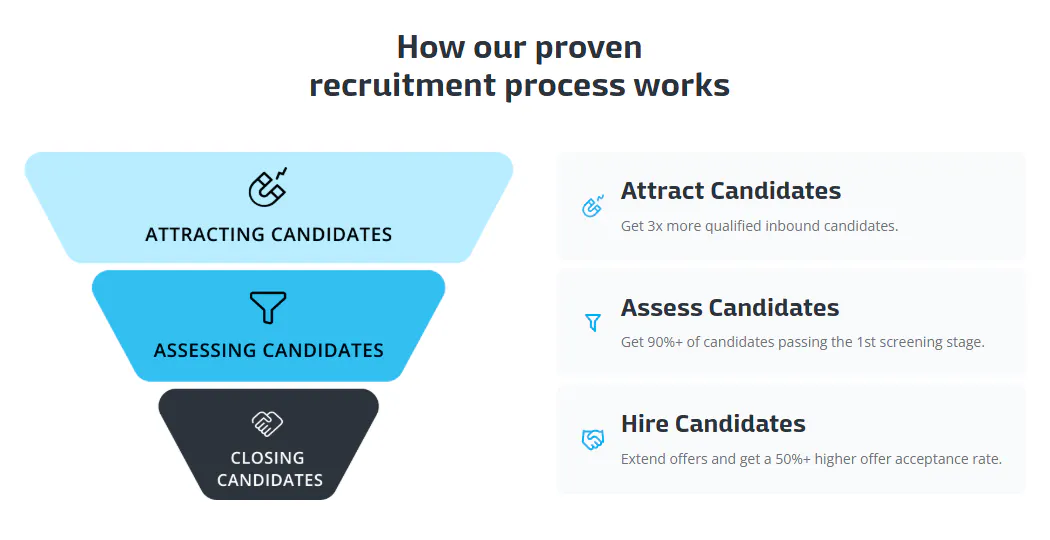
We review portfolios showing real shipped work, assess problem complexity through what candidates have actually built, verify tech stack relevance for exact matches with your needs, and evaluate learning velocity. We completely ignore arbitrary years requirements.
The results speak for themselves: 96% of our permanent hires since 2022 stayed beyond the 90-day guarantee, because we evaluate what actually predicts success; 90%+ of candidates pass first screening for genuine capability fit; and offer acceptance is 50%+ higher through better matching. You get access to pre-vetted developers in Portugal, Eastern Europe, and Latin America at 40-60% of US market rates.
First qualified candidates delivered within 48 hours. No payment until you hire.
Book a free consultation to discuss your specific needs and get matched with developers who've actually done the work you need.
FAQ
What correlation exists between years of experience and job performance?
Research shows years of experience has weak correlation with job performance after someone hits the 2-3 year mark. The problem: 10 years can mean either 10 years of genuine growth or 1 year repeated 10 times. A developer maintaining the same legacy system for 8 years develops different skills than someone shipping diverse products for 3 years. Technology evolves so rapidly that skills become outdated every 2-3 years in fast-moving domains, making recent relevant experience more valuable than dated extensive experience.
How can we evaluate developers without years requirements?
Focus on evidence of actual capability. Review portfolios showing shipped production code with real user impact. Use technical assessments that test problem-solving on challenges similar to your actual work. Conduct interviews evaluating architectural reasoning and decision-making. Check references specifically about past delivery and impact. Ask candidates to walk through complex problems they've solved with measurable outcomes. These methods reveal capability directly instead of using years as a proxy.
Won't removing years requirements flood us with unqualified applicants?
Specific technical requirements filter more effectively than years. "Built production React apps with TypeScript serving 50K+ users" is far more selective than "5+ years experience." The first requirement proves they can deliver exactly what you need. The second just measures time passed. You'll actually receive fewer but higher-quality applications because weak candidates who relied on years alone can't meet concrete technical criteria.
How do we determine junior vs senior level without years?
Define levels by capability, not tenure. Junior developers need guidance on architecture and complex problems. Mid-level developers work independently and make solid technical decisions. Senior developers design system architecture, mentor others, and make trade-off decisions affecting the entire product. Assess these capabilities through architectural discussions, past examples of mentorship or technical leadership, and how they approach ambiguous problems during interviews.
What if a great candidate doesn't meet our specific tech stack requirements?
Evaluate their learning velocity instead. Fast learners pick up new stacks in weeks. Look for evidence: self-taught new frameworks and shipped production code within months, proactively adopted emerging technologies, GitHub showing experimentation across different tools. Ask about past learning experiences - how quickly they've adapted to new languages or paradigms. Someone who learned React in 6 weeks will learn your stack just as fast.
Tech hiring insights in your inbox
From engineers to engineers: helping founders and engineering leaders hire technical talent.
We will only ever send you relevant content. Unsubscribe anytime.