

Posting a job on LinkedIn and waiting for applications is the number one recruiting mistake, yet 70% of companies do exactly that.
Here's why it fails: the best engineers don't browse job boards. They're employed, busy shipping code, and not actively job searching.
The data confirms this reality. Seventy-three percent of job seekers are passive candidates. They're open to opportunities but not actively looking. While you're waiting for inbound applications, your competitors are directly reaching the exact engineers you need.
This article explains why inbound recruiting fails for engineering roles specifically, what outbound recruiting actually involves, and provides a step-by-step implementation framework. Companies doing outbound fill roles 60% faster with better quality hires by accessing the 90% passive candidate market that inbound completely misses.
Key Takeaways
- Inbound recruiting produces bad signal to noise.
A typical engineering role pulls 250 to 500 applications and only 1 to 3% are qualified, which burns 40+ hours of review time. Direct sourcing surfaces the same quality of candidates in around 8 hours. - Speed is the real bottleneck.
52% of companies lose top candidates to faster competitors before they finish the process. Active job seekers are usually interviewing with 5 to 10 companies at once, which drives longer cycles and lower offer acceptance.
To stay competitive, respond to interest within 24 hours, schedule first interviews within 48, complete technical assessments inside a week, and extend offers within 2 to 3 days. - The best engineers aren't on job boards.
The top 10 to 20% are employed and passive. 90% of engineers who changed jobs responded to outreach or a referral, not a listing. Inbound recruiting simply can't reach them. - Outbound works because it targets the right people directly.
Sourcing on LinkedIn, GitHub, and Stack Overflow puts you in front of exact match engineers. Personalized messages land 20 to 40% response rates, compared to 2 to 5% for generic outreach.
Great outbound messages are short. Stay under 300 characters, recognize something specific about their work, state compensation upfront, mention a similar technical challenge you're solving, and close with an effortless calendar link.
Ready to hire better? Book a free consultation with Remote Crew.
Why Inbound Recruiting Fails for Engineering Roles
Most companies post a job on LinkedIn, wait for applications, and wonder why they can't fill engineering roles. The approach feels logical - advertise the opening and let candidates come to you. But there are four fundamental problems that make inbound recruiting ineffective for engineering talent.
The Best Engineers Aren't Job Searching
Seventy-three percent of engineers are passive candidates. They're employed, engaged in interesting work, learning constantly, and too busy shipping code to browse job boards. The engineers actively applying to your posting typically fall into three categories:
- juniors seeking first roles
- recently laid off workers (which requires an investigation into why)
- people struggling at their current company.
This doesn't mean passive candidates aren't open to new opportunities. They absolutely are. But they won't initiate the search because updating a resume takes effort, applying feels disloyal to their current employer, and they don't want their company to find out.
Signal-to-Noise Ratio Is Terrible
A typical engineering job posting generates 250-500 applications with only 1-3% qualified. The volume problem is massive: automated bot applications, candidates with entirely wrong tech stacks, international applicants without work authorization, and junior developers applying to senior roles.
Here's a concrete example: You post a backend Node.js role and receive 300 applications. Of those, 250 are frontend developers, PHP developers, or bootcamp graduates without relevant experience. You'll spend 40+ hours reviewing these applications to identify maybe 5 qualified candidates. Direct sourcing finds those same 5 qualified engineers in 8 hours.
You're Competing for the Same 10%
Active job seekers are interviewing with 5-10 companies simultaneously. This creates maximum competition, which drives longer hiring processes, higher salary expectations, and lower offer acceptance rates.
A bunch of companies struggle to secure top candidates before competitors do. By the time you finish your interview process, the best candidates have already accepted offers elsewhere.
Employer Brand Dependency
Inbound recruiting works consistently if you're Google, Meta, or Stripe. Well-known companies get hundreds of qualified applications because engineers actively want to work there. Unknown companies get few applications, and most are unqualified. This creates a huge disadvantage in the talent competition.
Outbound recruiting levels the playing field entirely. Direct sourcing finds talent regardless of employer brand recognition. When you reach out directly with a personalized message about relevant work and specific opportunities, you create interest that your brand alone wouldn't generate.
What Actually Works: Outbound Engineering Recruiting
Instead of posting jobs and hoping the right candidates apply, successful companies proactively identify and contact specific engineers directly. Here's how to implement outbound recruiting that actually fills roles.
Targeted Sourcing: Find Exact Candidates You Need
LinkedIn is your primary sourcing tool - 90% of recruiters use it for good reason. But we've found the best results come from combining multiple platforms: GitHub shows actual code and contributions, Stack Overflow reveals technical community engagement, and Twitter/X is surprisingly effective for AI and ML engineers.
Search for exact matches:
- specific tech stack combinations (React + TypeScript + Node.js)
- seniority level
- location or timezone compatibility
- evidence of shipping production code
Use Boolean searches like "React" AND "TypeScript" AND "Senior" NOT "Angular" for frontend roles, or "iOS Developer" AND "Swift" AND "SwiftUI" for mobile.
The advantage is dramatic: 100% of candidates identified as relevant versus 1-3% qualified from inbound applications. You're accessing passive candidates who never browse job boards.
The Concentric Circles Method
Start with your narrowest search criteria targeting the highest-fit candidates first. Your inner circle might be 20-30 engineers with an exact tech stack match, right seniority level, location compatibility, and portfolio evidence of relevant work.
Reach out to this inner circle first with highly personalized messages. Then expand circles only if needed: remove one requirement, increase experience from mid-level to senior, broaden geography from your city to your region, or add adjacent skills, like expanding React to Vue.js.
Why this works: it prevents burying strong candidates in massive lists you never reach, ensures the highest-fit candidates get contacted first with maximum personalization effort, and allows quality control at each stage.
Personalized Outreach That Gets Responses
Mass generic messages get 2-5% response rates. Personalized messages achieve 20-40% response rates. The difference is worth the effort.
Keep messages under 300 characters total with this structure: specific recognition of their work, your similar technical challenge, compensation range stated upfront, and an effortless response mechanism.
Here's what works: "Hi Sarah - saw your React dashboard work at Shopify. We're building similar real-time analytics for 100K users. $120-150K + equity, fully remote. Your WebSocket experience is directly relevant. Worth a quick chat? [calendar link]"
Send 10-15 personalized messages daily. Tuesday through Thursday, 9-11 am in their timezone gets the highest open rates. Follow up once after 5-7 days, then move on.
Speed Wins With Top Candidates
Top engineers evaluate opportunities within 48-72 hours. While hiring cycles for mid and senior-level roles typically take 40-50 days, fast companies complete the entire process in 1-2 weeks.
Respond to interest within 24 hours. Schedule the first interview within 48 hours. Complete technical interviews within one week. Extend offers within 2-3 days of the final interview.
Speed signals organizational competence. Slow companies lose candidates to faster competitors every single time.
How to Implement Outbound Recruiting: Step-by-Step
We've refined this process through hundreds of engineering hires. Here's the exact framework that works.
Step 1: Define Your Ideal Candidate Profile
- Start with technical precision. Specify your exact tech stack - React 18, TypeScript 4.9, Node.js 18 - not just "JavaScript developer." Include framework versions when they matter.
- Distinguish must-have from nice-to-have skills. Must-have: shipped production applications using your core stack. Nice-to-have: experience with your specific database or cloud platform.
- Calibrate seniority realistically. Junior engineers need daily guidance and structured tasks. Mid-level engineers work independently on defined problems. Senior engineers own architecture decisions and mentor others.
- Define location and timezone requirements upfront. Fully remote? Specific city only? Need four hours of timezone overlap for meetings? Clear criteria prevent wasted outreach.
Step 2: Source Targeted Candidates
- LinkedIn is your primary channel. Use Boolean search with technical filters: "React Developer" AND "TypeScript" AND "Senior" AND "[Your City]". Start narrow with your highest-fit criteria.
- We've found the concentric circles approach works best. Build your list in tiers: 20-30 highest-fit candidates (exact tech stack, right seniority, perfect location), then 50-70 good-fit candidates (relax one requirement).
- Reach the inner circle first. If response rates are low, expand to the next circle. This prevents strong candidates from getting buried in massive lists you never reach.
- Check GitHub profiles for matching repositories and contribution frequency. Look for portfolio evidence: published apps, open source contributions, technical blog posts, conference talks.
Step 3: Craft Personalized Messages
- Research each candidate individually before writing. Review their LinkedIn profile, examine GitHub repositories, and read any published work.
- Your message must stay under 300 characters, including spaces. Structure it this way: "Hi [Name] - saw your [specific work] at [Company]. We're building [similar challenge]. $120-150K + equity, fully remote. Your [specific expertise] is directly relevant. Worth a chat? [calendar link]"
- The key is specificity. Reference actual work they've done, not generic "I came across your profile" templates. Include a compensation range upfront and make responding effortless with a calendar link.
Step 4: Send Messages and Track Responses
- Send 10-15 personalized messages daily. Quality beats quantity - better to send fewer highly personalized messages than blast generic templates.
- Timing matters. We've found that Tuesday through Thursday mornings, 9-11 am in the candidate's timezone, generate the highest open rates.
- Track systematically: candidate name, message sent date, response received, interview scheduled, and final outcome. If your response rate drops below 20%, your messaging needs refinement.
- Follow up once after 5-7 days with additional value or information, then move on to the next candidates. Respond to any replies within 2-4 hours - speed demonstrates organizational respect.
Step 5: Move Fast Through the Interview Process
- Complete the entire process within two weeks maximum. Top engineers evaluate multiple opportunities simultaneously, and delay kills your chances.
- Schedule the first interview within 48 hours of a positive response. Conduct the technical assessment within one week of that initial conversation. Schedule final interviews within days of the technical assessment.
- Extend your offer within 2-3 days of the final interview. Every day of delay gives competitors time to make their offers first.
Inbound vs Outbound: The Data
We've analyzed hundreds of engineering hiring processes, and the numbers clearly favor outbound recruiting. Here's how the approaches compare on metrics that actually matter.
Metric | Inbound Recruiting | Outbound Recruiting | Why It Matters |
Time to First Qualified Candidate | 2-4 weeks | 48-72 hours | Speed to engage talent before competitors |
Qualified Rate | 1-3% | 80-90% | Time spent reviewing vs interviewing |
Candidate Pool | Active job seekers (10% of market) | Passive candidates (90% of market) | Access to top talent not actively searching |
Time to Hire | 6-8 weeks | 2-4 weeks | Business impact of unfilled engineering roles |
Hiring Manager Time | 40+ hours reviewing applications | 8-12 hours sourcing and outreach | Opportunity cost of engineering leadership time |
The data tells a clear story. Sourced candidates are 5x more likely to be hired than inbound applicants. Direct sourcing delivers 11% of hires from just 2.6% of applications - a 4x yield compared to job boards.
Bottom line: outbound is 3x faster, accesses a 9x larger talent pool (90% passive vs 10% active), and requires 75% less hiring manager time reviewing unqualified candidates. The math overwhelmingly favors proactive outreach over passive waiting.
Common Objections to Outbound Recruiting
We've heard every reason why companies hesitate to do outbound recruiting. Most of them are based on misconceptions. Let's address the four most common objections.
"Isn't cold outreach spammy?"
Here's the critical distinction: generic mass messages ARE spam. Personalized, relevant messages are professional outreach.
Engineers ignore recruiter spam, but they respond to messages showing you actually researched them. We've seen this play out hundreds of times - personalized outreach gets 30-40% response rates, while generic templates get 2-5%.
The response rates prove it's valuable communication, not spam. If nearly 40% of engineers reply positively, you're not bothering them - you're offering something relevant. Data backs this up: 82% of candidates expect a personalized approach in recruitment. Showing you researched them demonstrates respect.
"We don't have time for outreach"
This is a time comparison problem. Let's look at the actual numbers.
Reviewing 300 inbound applications takes 40+ hours to find 5 qualified engineers. Sourcing and contacting 30 targeted candidates takes 8-12 hours to find the same 5 qualified engineers.
Outreach is MORE time efficient when you measure quality-per-hour, not just activity volume. You're spending less time on higher-quality results.
If you genuinely don't have capacity, work with a recruiting specialist like Remote Crew who handles sourcing, outreach, and pre-screening as their core competency.
"Won't passive candidates be unmotivated?"
Passive doesn't mean unmotivated - it means currently employed and not actively job searching.
Top performers are typically passive. They're engaged in current work, getting promoted, working on interesting projects. That's 70-73% of the workforce. Active job seekers often fall into categories requiring investigation: juniors seeking first roles, recently laid off, or struggling at current positions.
Passive candidates make careful, considered decisions. This higher-quality evaluation process leads to better long-term fit and higher retention.
"Our company isn't well-known enough"
This is precisely WHY outbound works for you.
Famous companies win with inbound based on brand recognition alone. Unknown companies must do outbound to level the playing field and compete for top talent.
A personalized message creates immediate relevance regardless of brand. "I researched you specifically" trumps "I'm from a famous company" every time. Direct outreach bypasses your brand disadvantage by demonstrating genuine interest and fit.
Action Steps: Switch From Inbound to Outbound
Ready to implement outbound recruiting? Here's your action plan:
- Stop waiting for inbound. Keep job postings active, but allocate 80% of effort to outbound sourcing.
- Build your sourcing process. Document ideal candidate profile. Create 3-5 LinkedIn Boolean searches. Identify 20-30 highest-fit candidates, expand to 50-70 good-fit.
- Create message framework. Structure with specific recognition, technical relevance, compensation transparency, easy response. Customize for each candidate. Under 300 characters.
- Start daily outreach. Send 10-15 personalized messages daily. Track responses. Target 20-30% response rates. Follow up once after 5-7 days.
- Optimize for speed. Respond within 2-4 hours. First interview within 48 hours. Complete process within 2 weeks.
- Consider recruiting specialists. If limited capacity, hard-to-find specialties, or urgent needs, partner with specialized firms.
Let Remote Crew Handle Outbound Recruiting For You
If you want the results of outbound recruiting without doing it yourself, Remote Crew specializes in this exact approach for engineering hiring.
Our process combines targeted sourcing from established pre-vetted networks in Portugal, Eastern Europe, and Latin America with personalized outreach to passive candidates. We technically pre-screen every engineer before introduction, so you're not wasting time on unqualified candidates. First qualified candidates delivered within 48 hours of engagement.
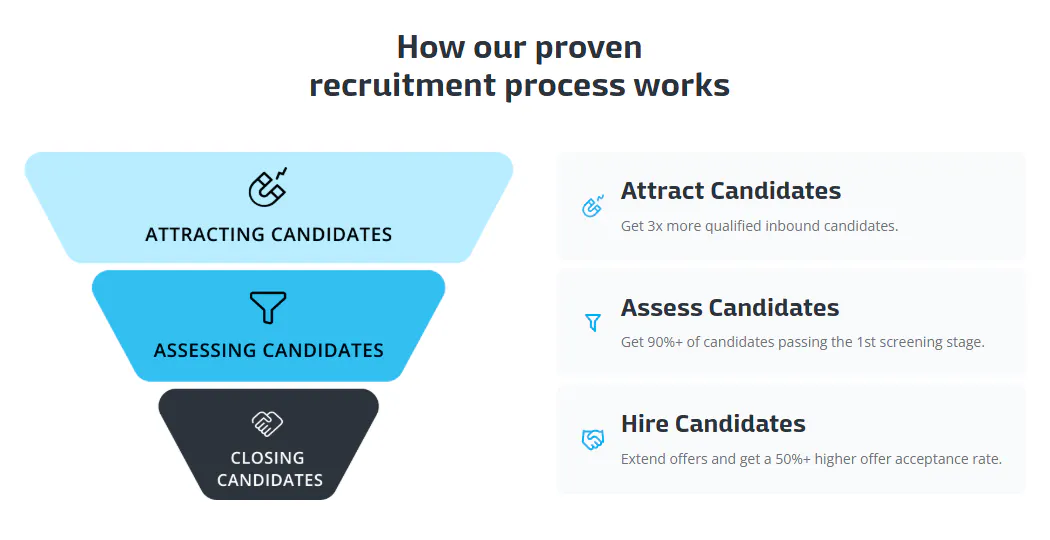
Why we're effective: We've built engineering networks over the years in regions where top developers work at 40-60% of US rates. Our full-time sourcing team has the technical depth to evaluate React vs Angular or Node.js vs Python properly. Our proven messaging frameworks consistently achieve 35-40% response rates.
The results speak for themselves: 96% of our permanent hires since 2022 stayed beyond the 90-day guarantee, 90%+ of introduced candidates pass your first screening stage, 50%+ higher offer acceptance rates, and 60% faster time-to-hire compared to traditional inbound recruiting.
We operate on a risk-free model - no payment until you hire.
Book a free consultation to discuss your engineering hiring needs and receive your first qualified candidates within 48 hours.
FAQ
What is outbound recruiting and how does it differ from inbound recruiting?
Outbound recruiting means proactively identifying specific engineers who match your needs and contacting them directly through personalized messages. Inbound recruiting posts job listings and waits for applications. The difference is access: inbound reaches only the 10% actively job searching, while outbound accesses the 90% passive candidate market - employed engineers open to opportunities but not browsing job boards. Outbound fills roles 60% faster with better quality hires.
Why do passive candidates respond to outreach if they're not looking for jobs?
Passive candidates are employed and not actively searching, but they're absolutely open to better opportunities. Direct outreach works because responding is low-effort (just reply), completely private (unlike updating public profiles), and flattering - you specifically sought them out. When messages mention their actual work and relevant challenges, it overcomes the inertia of applying cold. The 30-40% response rates prove this approach works consistently.
What response rate should I expect from personalized outbound messages?
Highly personalized messages mentioning specific work achieve 20-40% response rates, while generic templates get only 2-5%. Factors affecting your rate include message quality, target accuracy, company positioning, and compensation competitiveness. If you're consistently below 20%, your messaging needs refinement - add more specific recognition of their work, state compensation upfront, and make responding effortless with calendar links.
How long does it take to see results from outbound recruiting?
You'll get first responses within 24-48 hours of sending messages. Expect first qualified candidates identified within 1 week, first interviews scheduled within 2 weeks, and first hires within 3-4 weeks if your process moves fast. Compare this to 6-8 weeks for typical inbound timelines. Speed matters - top engineers evaluate opportunities within 48-72 hours, so fast execution wins candidates before competitors.
Is outbound recruiting more expensive than posting jobs on LinkedIn or Indeed?
Job board postings cost $300-1000/month but generate 1-3% qualified rates, meaning $10,000-30,000 effective cost per qualified candidate. Outbound costs $50-100/hour for recruiter time or 15-25% placement fees. Factor in the 40+ hours hiring managers spend reviewing unqualified inbound applications versus 8 hours finding the same qualified candidates through direct sourcing. Outbound delivers better ROI through quality and speed.
Tech hiring insights in your inbox
From engineers to engineers: helping founders and engineering leaders hire technical talent.
We will only ever send you relevant content. Unsubscribe anytime.