

"AI developer" has become the most expensive job posting mistake in 2026. The term covers everything from calling OpenAI's API to building neural networks from scratch. Companies waste weeks interviewing mismatched candidates because AI Engineer (LLM applications), ML Engineer (model training), and Data Scientist (analytics) require completely different assessments.
Here's what most miss: you probably need an AI Engineer building applications with an existing model rather than an ML researcher. But hiring playbooks haven't caught up, even as AI became mission-critical in 2024-2026.
At Remote Crew, we've hired 150+ developers and interviewed 1,500+ candidates. This guide adapts those frameworks for AI hiring. You'll learn how to define your actual need, write descriptions that attract the right profiles, and test production AI knowledge.
Key Takeaways for Hiring AI Developers in 2026
- Define your AI developer type before posting: Most companies need AI Engineers (builds LLM apps via APIs), not ML Engineers (trains models) or Data Scientists (analyzes data).
- Specify concretely: "Build RAG system reducing support tickets by 30%," not "add AI to product"
- Get the founder and tech lead sign-off before posting
- LLM applications beat custom models for most use cases: Start with LLM APIs unless you have proprietary data advantage, scale exceeding $10K/month API costs, or regulatory constraints.
- LLM applications ship in weeks, custom models take months
- 80% of companies in 2026 need AI Engineers, not ML researchers
- Experience recency matters more than tenure: The field evolved dramatically from 2022 to 2024. 2 years of hands-on LLM experience outperforms 6 years of traditional ML without modern tools.
- Test for learning agility and current LLM knowledge, not outdated ML theory
- Outreach beats job boards: 90% of top AI developers respond only to targeted outreach due to extreme demand.
- Target OpenAI, Anthropic, Hugging Face alumni, and companies with production AI
- Personalize: specific AI challenge, framework needed, salary range upfront
- Remote hiring cuts costs 40-60%: Senior AI developers in Portugal, Eastern Europe, and Latin America ($60-100K) versus US rates ($160-220K+).
- Test for production thinking: Practical tests under 2 hours (RAG implementation, prompt engineering) reveal more than interviews.
- Candidates who explain trade-offs clearly and show cost awareness perform best in production
Ready to hire? Book a free consultation with Remote Crew and get your first qualified AI developer within 48 hours.
When Do You Need AI Developers
- Building LLM-powered applications (chatbots, copilots, document processing)
- Implementing RAG systems for knowledge base search
- Integrating AI APIs (OpenAI, Anthropic, Hugging Face) into existing products
- Training or fine-tuning custom ML models for specific use cases
- Building MLOps pipelines for model deployment and monitoring
- Adding AI features to existing products (recommendations, classification, generation)
AI Engineer vs ML Engineer vs Data Scientist: Which Do You Need?
AI Engineer builds applications using AI APIs and LLMs: integrates existing models, designs RAG systems, engineers prompts, and implements vector databases. Needs: Python, LangChain/LlamaIndex, OpenAI/Anthropic APIs, vector databases, and prompt engineering.
When to hire an AI Engineer:
- Chatbots, document Q&A, semantic search, and content generation
- Workflow automation with LLMs
- Rapid prototyping and MVP development
- Note: 80% of companies in 2026 need AI Engineers - LLM APIs are powerful enough for most use cases
ML Engineer trains and fine-tunes models: builds custom neural networks, fine-tunes foundation models, optimizes performance, and deploys to production. Needs: PyTorch/TensorFlow, mathematics (linear algebra, calculus), MLOps tools, cloud AI platforms.
When to hire an ML Engineer:
- Proprietary data provides a competitive advantage
- Domain-specific tasks where LLMs underperform
- Massive-scale cost optimization (API costs exceed $10K/month)
- Real-time inference or on-premise regulatory requirements
Data Scientist analyzes data and builds statistical models: explores datasets, creates visualizations, builds predictive models, runs A/B tests. Needs: Python/R, SQL, statistics, Pandas/NumPy, visualization tools, scikit-learn.
When to hire a Data Scientist:
- Analyzing business metrics and forecasting
- Building recommendation systems
- Measuring experiments and finding insights
Warning: Posting "AI/ML/Data Science Developer" without specifying type attracts all three profiles - you'll reject 66% of candidates for role mismatch. Define your use case first, then target the specific profile.
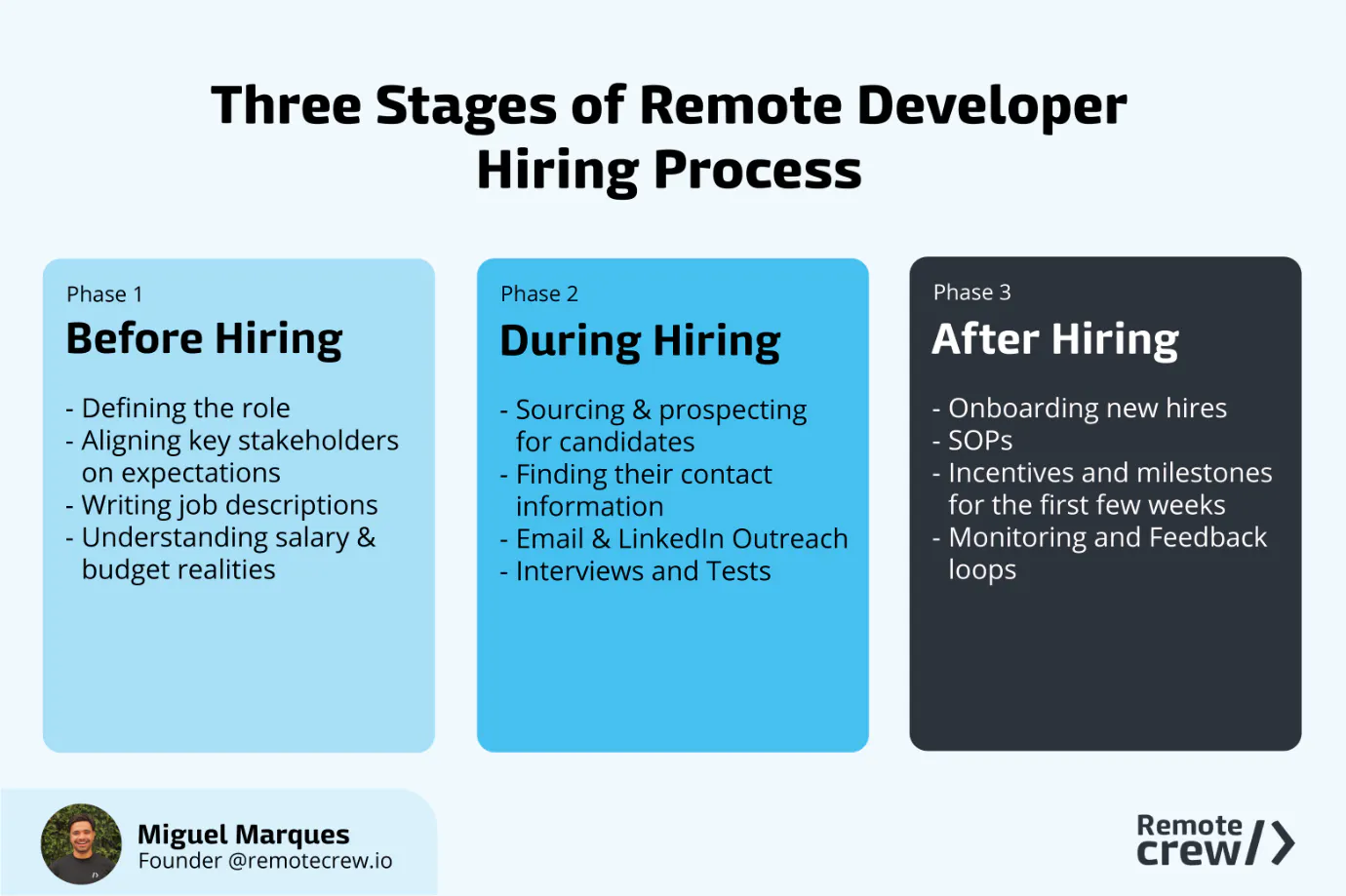
Three Stages of Hiring AI Developers
Most companies jump straight to interviewing and wonder why they waste weeks on mismatched candidates. After 1,500+ interviews, we've found hiring AI developers requires three phases.
Phase 1 - Before Hiring determines 80% of success. Define whether you need an AI Engineer, ML Engineer, or Data Scientist. Specify LLM application versus custom model use cases. Create a 1-page AI-specific recruitment plan. Understand AI developer salary premiums of 20-40% above general developers. Write job descriptions that attract the right AI profile.
Phase 2 - During Hiring focuses on attracting A players. Source on LinkedIn using concentric circles targeting AI-specific companies. Interview with structured questions testing production experience, not theoretical knowledge. Run technical tests under 2 hours, focused on problem-solving.
Phase 3 - After Hiring covers onboarding. This guide focuses on Phases 1 and 2 - identifying and hiring the right AI developers before they join.
Part 1: What You Need to Do Before Hiring AI Developers
Most companies skip this phase and jump straight to posting jobs. That's why they waste weeks interviewing AI Engineers when they need ML researchers, or vice versa. After hiring 150+ developers and interviewing 1,500+ candidates, we've found that this preparation phase determines 80% of your hiring success before you ever write a job post.
Create Your 1-Page Recruitment Plan for AI Developers
The best approach we've found starts with a single-page document that forces alignment before you waste time on mismatched candidates.
Your recruitment plan needs three sections:
Business Problem: Specify the exact AI challenge with metrics. "Build RAG system reducing support tickets by 30% while maintaining 90% accuracy" tells you exactly what role you need. "Add AI to our product" tells you nothing and attracts everyone from prompt engineers to ML researchers.
Technical Requirements: Separate must-haves from nice-to-haves explicitly. For AI Engineers: Python 3.9+, LangChain or LlamaIndex, LLM APIs (OpenAI/Anthropic), prompt engineering, vector databases. For ML Engineers: PyTorch or TensorFlow, mathematics background, MLOps experience, model training.
Why They'd Join: AI developers command 20-40% premiums over general developers and have multiple options. You need compelling answers. Highlight specific technical challenges they'll solve, proprietary data advantages they'll work with, autonomy over AI architecture decisions, learning opportunities from experienced team members, clear growth path, and mission-critical impact.
Get your founder, engineering lead, and technical interviewers to sign off on this document before posting anything. Disagreements surface now or during interviews when you've already wasted 10 hours on a candidate.
Download our free 1-page AI recruitment plan template to kickstart this process.
LLM Application vs Custom ML Model: Defining Your Use Case
This decision determines whether you need an AI Engineer or an ML Engineer entirely. Most companies get this wrong.
- LLM Application (hire AI Engineer): You're using existing models via API or RAG, no training required. Faster to ship (weeks), cheaper (API costs), less ML expertise needed. Right for: chatbots, document Q&A, content generation, semantic search, workflow automation, MVPs.
- Custom ML Model (hire ML Engineer): You're training or fine-tuning models on your data. Slower (months), expensive (GPU costs, data labeling), requires ML expertise and large datasets. Right for: proprietary data providing competitive advantage, domain-specific tasks where LLMs fail, massive scale where API costs exceed $10K+/month, real-time inference with latency constraints, and on-premise regulatory requirements.
Here's the reality: 80% of companies in 2026 need AI Engineers building LLM applications, not ML researchers. Foundation model APIs like GPT-4, Claude, and Gemini are powerful enough for most use cases and improve monthly.
Start with LLM APIs unless you have proprietary data that provides a measurable advantage, scale where API costs justify custom models, or hard constraints that prevent API usage.
Understanding AI Developer Seniority Levels
The AI field evolved dramatically between 2022 and 2024, which changes how you evaluate experience.
Junior (1-3 years): Python basics, LLM API integration, prompt engineering fundamentals, simple RAG implementation, Hugging Face usage, vector database basics. Can build functional chatbots with guidance.
Mid (3-5 years, 1-2 years AI): Advanced RAG architectures, vector database optimization, LLM fine-tuning (LoRA/QLoRA), MLOps basics, AI evaluation frameworks, multi-agent systems, cost optimization. Can design RAG systems independently.
Senior (5+ years, 2+ years hands-on LLM): AI system architecture at scale, advanced fine-tuning strategies, MLOps pipeline design, AI evaluation and safety, technical leadership, build vs buy vs fine-tune trade-offs. Can an architect produce AI systems that handle millions of requests?
The critical warning: 2 years of hands-on LLM experience (RAG, prompt engineering, production debugging) outperforms 6 years of ML research without modern LLM work. Recency matters more than tenure. Techniques from 2021 are outdated, new tools emerge monthly, and best practices change quarterly.
Salary Expectations for AI Developers
AI developers command the highest premiums we've seen - 20-40% above general developers at equivalent experience levels. The combination of extreme demand, limited supply, and rapidly evolving skillsets drives this.
Developers with hands-on RAG, LangChain, and prompt engineering experience command top-tier rates because this combination is rare.
Region | Junior (Annual) | Mid-Level (Annual) | Senior (Annual) | Hourly Rate (Specialized/Contract) |
North America | $70K-$95K | $110K-$160K | $160K-$220K | $120-$180 |
Western Europe | $55K-$75K | $85K-$120K | $120K-$170K | $95-$145 |
Eastern Europe | $35K-$55K | $55K-$85K | $80K-$115K | $60-$95 |
Portugal | $33K-$50K | $50K-$78K | $72K-$108K | $55-$90 |
Latin America | $30K-$48K | $48K-$72K | $66K-$102K | $48-$84 |
Remote hiring from Portugal and Eastern Europe offers comparable AI talent at 40-60% of US rates. That's $60-80K versus $140-180K for senior roles - same quality, dramatically lower cost.
How to Write a Compelling Job Description for AI Developers
Start with the specific AI problem they'll solve, not your company history. "Build RAG-powered customer support processing 10K daily queries, reducing resolution time 40% while maintaining 95% accuracy" beats "We're a growing AI startup."
The critical mistake: requiring "AI/ML/Data Science experience" together as if they're interchangeable. These are different roles. You'll attract mismatched candidates.
Specify AI developer type explicitly in your title: "AI Engineer - LLM Applications" or "ML Engineer - Model Training," not vague "AI/ML Developer." The first line should clarify whether they'll build RAG systems using LangChain and OpenAI API versus train models using PyTorch.
AI Developer Job Description Must-Haves:
- AI developer type (AI Engineer/ML Engineer/Data Scientist)
- Python version (3.9+ for AI work)
- LLM APIs or custom training
- Key frameworks (LangChain/LlamaIndex for AI Engineers, PyTorch/TensorFlow for ML Engineers)
- Vector database experience if role involves RAG
- Cloud platform if relevant (AWS SageMaker, GCP Vertex AI, Azure ML)
- Salary range (critical - AI developers skip unclear postings)
- Red flag to avoid: Never list "AI/ML/Data Science" together
Frame the role as a growth opportunity: describe technical challenges they'll own, learning opportunities from senior team members, and advancement path (AI Engineer to Senior to Lead within 18-24 months).
Part 2: During Hiring - How to Identify the Best AI Developers
The best AI developers aren't browsing job boards. They're getting messages from recruiters daily, so when they're open to new opportunities, they respond to outreach rather than applying. If you're waiting for applications, you're competing for whoever's left after other companies contacted your ideal candidates first.
How to Source AI Developers on LinkedIn
We've tried many different ways to find and reach ideal candidates, and the concentric circles method works best because it prevents strong candidates from getting buried in massive lists you never reach due to time constraints.
Start narrow with your LinkedIn search: Python, LangChain OR LlamaIndex (for AI Engineers) or PyTorch OR TensorFlow (for ML Engineers), AI Engineer or ML Engineer in title, 3-5 years experience, target location. Reach out to this tier first, then progressively expand by removing "open to work" filters.
Target companies with strong AI teams: OpenAI, Anthropic, DeepMind, Hugging Face, Cohere, Scale AI, and companies with production AI like Notion, Intercom, and Jasper. Check GitHub for AI project contributions and Hugging Face profiles for model uploads.
Your outreach message must stay under 300 characters for LinkedIn. Include specific AI work you noticed, a concrete technical challenge, and salary range.
Example: "Hi Maria - saw your RAG implementation at [company]. We're building similar system for legal document Q&A, your vector database optimization would be directly relevant. $140-180K + equity, fully remote, modern LLM stack. Worth a quick chat? [link]"
What Questions to Ask During the Interview for an AI Developer Role
AI moves fast, so focus on problem-solving and reasoning rather than memorizing APIs that change quarterly. These questions reveal depth of knowledge and production experience:
- RAG vs fine-tuning trade-offs: "Explain the difference between RAG and fine-tuning - when would you choose each?" Tests fundamental AI architecture decision-making.
- LLM application evaluation: "Walk through how you'd evaluate the quality of an LLM-powered application." Tests production AI experience where defining success metrics is non-trivial.
- Handling hallucinations: "How do you handle hallucinations in LLM applications?" Tests practical production knowledge versus tutorial-level experience.
- Vector databases and semantic search: "Describe your experience with vector databases - how does semantic search differ from keyword search?" Tests the RAG system's depth of knowledge.
- Cost optimization: "How would you optimize LLM API costs in a high-volume application?" Tests production economics awareness.
- Production deployment: "Walk through a time you deployed an AI model to production - what monitoring did you set up?" Tests MLOps awareness even for AI Engineers.
- Staying current: "How do you stay current with AI developments given how fast the field moves?" Testing learning agility is crucial for AI roles.
- Prompt engineering approach: "What's your experience with prompt engineering and how do you approach it systematically?" Tests the LLM application depth.
Green Flags vs Red Flags for AI Developers
Category | Green Flags | Red Flags |
AI Type Clarity | Clearly explains the AI Engineer vs ML Engineer specialty, focuses on relevant experience | Claims expertise in all three roles equally, vague about actual contributions |
LLM Knowledge | Discusses specific model capabilities/limitations, aware of GPT-4/Claude/Gemini differences, understands fine-tuning vs API trade-offs | Treats all LLMs as interchangeable, superficial prompt engineering knowledge |
Production Experience | Specific examples of production AI systems built, discuss monitoring/debugging, mention scale challenges | Only tutorial/personal projects, can't explain production challenges solved |
Evaluation Mindset | Discusses multiple evaluation approaches (automated metrics, human eval, user satisfaction) | No systematic evaluation approach assumes outputs are always correct |
Framework Proficiency | Deep knowledge of one main framework explains when to use fthe ramework vs raw API | Claims expertise in every framework, surface-level knowledge |
Candidates showing 7+ green flags typically pass probation with a 95%+ success rate based on our placement data.
How to Do Technical Testing for AI Developers
Keep tests under 2 hours. Longer tests filter out candidates with options. Provide starter templates with basic setup (Python environment, API keys), so candidates implement AI-specific skills rather than environment configuration.
Sample test projects:
- Build a basic RAG system with the provided documents (tests implementation, vector database usage, prompt engineering)
- Implement prompt engineering for a classification task with accuracy measurement (test systematic approach, cost optimization)
- Design an AI system architecture for the given use case (written response evaluating trade-offs)
What to evaluate: Python code quality, AI framework usage, evaluation approach, cost awareness, production readiness thinking.
Schedule a review call where candidates explain their decisions, discuss alternatives, and respond to hypothetical changes. This reveals depth of understanding beyond the code itself.
AI Developer Skills - Complete Checklist
Must-have skills:
- Python proficiency
- LLM API integration (OpenAI/Anthropic/Hugging Face)
- Prompt engineering
- RAG system design
- Vector databases (Pinecone/Weaviate/Chroma)
- Basic ML concepts
- Git version control
- API design for AI services
Nice-to-have skills: - PyTorch/TensorFlow for custom models
- MLOps tools (MLflow, DVC)
- Fine-tuning experience
- Cloud AI platforms (SageMaker, Vertex AI)
- Multi-agent systems (AutoGen, CrewAI)
- Evaluation frameworks
- Docker containerization
- Data pipeline experience
Soft skills critical for remote: - Learning agility (AI evolves monthly)
- Clear communication about AI limitations and trade-offs
- Self-direction in rapidly changing landscape
- Strong documentation habits
Common Mistakes When Hiring AI Developers
- Posting "AI developer" without specifying AI Engineer vs ML Engineer vs Data Scientist. You'll attract all three profiles and waste weeks interviewing mismatched candidates for role clarity you should have defined upfront.
- Hiring ML researchers when you need AI application engineers (over-hiring for the use case). Most companies in 2026 need AI Engineers building LLM applications, not PhDs training custom models. Hiring a researcher for API integration frustrates everyone.
- Requiring years of experience in tools that didn't exist 2 years ago. Demanding "5+ years AI experience" filters out candidates with 2 years of hands-on LLM work who outperform 6-year ML researchers without modern GenAI experience. LangChain didn't exist two years ago.
- Testing with outdated ML questions instead of modern LLM/GenAI scenarios. Using traditional ML interview questions when you need RAG expertise misses the actual skills required for your role.
- Ignoring Python code quality - notebook-quality code doesn't work in production. Many AI developers write exploratory code that never survives production deployment. Test for production-ready Python, not just working demos.
- Not assessing production experience - demos and prototypes require different skills than production systems. Building a tutorial chatbot differs entirely from deploying AI systems handling millions of queries with monitoring, cost optimization, and quality assurance.
- Overlooking learning agility - more important in AI than any other developer category. AI evolves monthly with new models, frameworks, and best practices. Developers who can't adapt quickly fall behind immediately.
- Waiting for inbound applications - best AI developers respond to targeted outreach only. The scarcest talent has multiple opportunities and never browses job boards. Passive waiting guarantees you miss A-players.
AI Developer Hiring Checklist
Before Hiring
- Create a 1-page recruitment plan defining AI developer type (AI Engineer vs ML Engineer vs Data Scientist)
- Specify business problem with metrics: "Build RAG system reducing support tickets by 30%," not "add AI"
- Separate must-have skills from nice-to-haves
- Get founder and tech lead sign-off before posting
- Set a realistic budget - AI developers command a 20-40% premium over general developers
Sourcing
- Use LinkedIn concentric circles: Python + LangChain/PyTorch + AI type + location, expand progressively
- Target AI companies: OpenAI, Anthropic, Hugging Face, companies with production AI teams
- Check GitHub for AI contributions and Hugging Face profiles
- Send personalized outreach under 300 characters, explaining specific relevance
Assessment
- Ask AI-specific questions: RAG vs fine-tuning, handling hallucinations, cost optimization,and evaluation approaches
- Look for 7+ green flags: production experience, learning agility, cost awareness, systematic evaluation
- Assess Python code quality alongside AI knowledge
Testing
- Keep tests under 2 hours with starter templates
- Options: RAG implementation, prompt engineering task, architecture design
- Evaluate problem-solving and production thinking, not memorized APIs
- Schedule a review call to discuss solutions
Evaluation
- Verify hands-on LLM experience - 2 years of recent experience outperforms 6 years without modern tools
- Assess learning agility and staying current
Should You Hire AI Developers On-Site or Remote?
Remote hiring wins decisively for AI developers. Given extreme talent scarcity and global distribution of AI expertise, limiting yourself to local markets means competing for a tiny pool at premium rates.
Here's how the economics and access compare:
Criteria | Remote Hiring | On-Site Hiring | Why It Matters |
Talent Pool | Global AI specialists (millions) | Local AI talent (hundreds) | AI developers are extremely scarce - remote expands options dramatically |
Time to Hire | 48 hours to the first candidates | 2-4 weeks minimum | Speed is critical as competitors target the same talent |
Cost Range (Senior) | Portugal/Eastern Europe $72-108K, LatAm $66-102K | US $160-220K | 2x team at the same budget or major savings |
AI Specialists Access | High availability in AI hub regions | Very limited outside SF/NY/Seattle | Most US cities lack local AI talent pools |
Infrastructure Costs | $0-minimal | $3-7K per seat | Significant overhead savings |
The math is straightforward: remote hiring gives you access to AI talent hubs like Portugal, Eastern Europe, and Latin America at 40-60% of US costs without quality trade-offs. You can build twice the team at the same budget.
On-site only makes sense for highly regulated industries requiring physical presence or classified work requiring security clearances.
Let the Experts Find the Best AI Developers for You
Remote Crew specializes in AI developer hiring through pre-vetted networks in Europe and Latin America. We distinguish AI Engineers from ML Engineers from Data Scientists-the profiles companies constantly misidentify.
Our AI-specific screening tests production LLM experience (RAG implementation, prompt engineering, handling hallucinations, cost optimization), modern frameworks (LangChain, vector databases), and learning agility for this rapidly evolving field.
We deliver the first candidates within 48 hours by tapping pre-vetted networks in AI hub regions. Time-to-hire drops from 12-16 weeks to 4-6 weeks.
The model is risk-free, no payment until you hire your chosen candidate. No upfront fees or retainers.
Results: 99% of placed developers pass probation (vs industry average 85%), 90%+ of submitted candidates pass first technical screening, and clients make hiring decisions after reviewing just 4-5 candidates (vs typical 20+ interviews).
Book a free consultation. Discuss your specific AI use case, get matched with pre-vetted candidates, and start interviewing within 48 hours.
FAQ
What's the difference between an AI Engineer and an ML Engineer, and which do I need?
AI Engineers build applications using existing AI models via APIs such as GPT-4 or Claude. They handle integration, RAG systems, prompt engineering, and vector databases using Python and LangChain. ML Engineers train and fine-tune custom models from scratch, requiring expertise in PyTorch, TensorFlow, mathematics, and MLOps. In 2026, 80% of companies need AI Engineers for chatbots, document Q&A, and semantic search because foundation model APIs handle most use cases. Only hire ML Engineers if you have proprietary data that provides a competitive advantage, API costs exceeding $10K monthly, or regulatory constraints requiring on-premise deployment.
How much should I expect to pay for AI developers in 2026?
AI developers command 20-40% premiums over general software developers. US salaries range from $70-95K for junior roles to $160-220K for senior positions. Remote hiring cuts costs significantly: Portugal offers $33-108K and Latin America $30-102K for equivalent quality at 40-60% savings. Specialized AI contractors charge $48-180 per hour, depending on region and expertise. Budget for these premiums, but evaluate remote options given the substantial cost advantages without sacrificing quality.
Should I hire someone to build custom ML models or use LLM APIs for my AI project?
Start with LLM APIs unless you have specific reasons for custom models. APIs ship faster, cost less initially, and improve monthly as foundation models advance. They work well for chatbots, content generation, and semantic search. Build custom models only when you have proprietary data providing a measurable competitive advantage, scale where API costs exceed $10K monthly, real-time latency requirements, or on-premise regulatory constraints. This decision determines whether you need an AI Engineer (APIs) or an ML Engineer (custom models).
What's the most important skill to test when interviewing AI developers?
Production experience with real AI systems at scale matters most. Test how candidates handle LLM hallucinations in production, optimize API costs, evaluate system quality systematically, and debug issues at volume. Also assess learning agility by asking how they stay current with AI developments and adapt to new tools. The field evolves so rapidly that 2024 best practices differ from 2023. Production experience combined with learning agility predicts success better than years of experience or theoretical knowledge alone.
How long does it take to hire an AI developer with a structured process?
A structured process takes 4-6 weeks total. Preparation takes 3-5 days to create your recruitment plan and align stakeholders. Sourcing takes 1-2 weeks, with the first candidates arriving within 48 hours. Screening and interviews take 2-3 weeks to meet 4-5 qualified candidates. Offer and onboarding take 1-2 weeks. Without structure, hiring stretches to 12-16 weeks because companies waste time interviewing mismatched candidates when they didn't clearly define AI Engineer versus ML Engineer requirements upfront. Specialized agencies deliver first candidates in 48 hours through pre-vetted networks.
Tech hiring insights in your inbox
From engineers to engineers: helping founders and engineering leaders hire technical talent.
We will only ever send you relevant content. Unsubscribe anytime.