

When you post a "Java developer" job, you'll get applications from Spring Boot microservices developers building cloud-native apps, legacy Java EE developers maintaining enterprise monoliths, Android developers building mobile apps, and big data engineers working with Hadoop and Spark. They're all "Java developers" - but they use completely different tech stacks.
As a result, companies waste weeks interviewing Java EE developers for Spring Boot roles, or developers stuck on Java 8 when they need modern Java 17+ expertise. The job posting didn't specify a framework or version.
We've hired 150+ developers and interviewed 1500+ candidates across every specialization. The pattern is clear: high-performing Spring Boot developers look nothing like legacy Java EE maintainers.
This guide shows you how to specify "Spring Boot Developer (Java 17+) building microservices REST APIs" instead of a generic "Java developer" - reducing interview waste and hiring the right talent.
Key Takeaways: Hiring the Right Java Developer
- Posting generic "Java developer" jobs attracts the wrong candidates
- Spring Boot microservices developers, legacy Java EE maintainers, Android mobile developers, and big data engineers all apply, despite using completely different tech stacks
- Always specify framework and version in job titles: "Spring Boot Developer (Java 17+)" instead of vague "Java developer"
- Modern Spring Boot developers and legacy Java EE developers are not interchangeable
- Spring Boot 3.x developers: Java 17+, microservices architectures, Docker, Kubernetes
- Java EE developers: Monolithic applications on WebLogic/WebSphere, often still running Java 8
- Retraining takes 3-6 months
- Define must-haves before hiring
- Java version (17 or 21 LTS for modern projects)
- Exact framework (Spring Boot 3.x vs Java EE)
- Required Spring ecosystem components (Spring Data JPA, Spring Security, Spring Cloud)
- Database skills (PostgreSQL/MySQL with Hibernate)
- Containerization knowledge (Docker and Kubernetes)
- Seniority levels have concrete technical markers
- Junior: Implement features with guidance, know one framework
- Mid-level: Ship complete features independently, optimize database queries
- Senior: Make architectural decisions about microservices design and service boundaries
- Framework-specific technical testing required
- Test Spring Boot dependency injection and auto-configuration (not generic Java algorithms)
- Test Spring Data JPA and N+1 query prevention
- Test REST API design with Spring MVC
- Don't test generic Java - test Spring Boot framework expertise
Ready to hire modern Java developers? Book a free consultation with Remote Crew and get your first qualified candidates within 48 hours.
When Do You Need Java Developers
You need Java developers for completely different scenarios - and each requires a different specialization.
- Building backend microservices with Spring Boot for scalable applications (requires Java 17+ and Spring ecosystem)
- Creating RESTful APIs for web and mobile applications (requires Spring MVC expertise)
- Developing enterprise applications requiring robustness and performance (caching strategies, database optimization, performance tuning)
- Maintaining or modernizing existing Java applications (Java EE to Spring Boot migration, monolith-to-microservices refactoring, upgrading Java 8 to Java 17+)
- Building cloud-native applications on AWS/GCP/Azure (requires Docker containerization, Kubernetes deployment, cloud service integration)
- Working with big data processing (Hadoop, Spark, Kafka)
- Developing Android mobile applications (entirely separate specialization)
The critical mistake: posting a generic "Java developer" job for Spring Boot microservices attracts Android developers and Java EE specialists - completely wrong skill sets.
Defining a Java Developer for Your Company
Posting "Java developer" without specifying the framework or Java version is the biggest mistake we see. That vague title attracts Spring Boot microservices developers, legacy Java EE developers maintaining 15-year-old monoliths, Android mobile developers, and big data engineers - completely different skill sets that waste everyone's time.
Before you write a single job description, decide exactly which type of Java developer you need.
Modern Spring Boot Developer (Java 17+)
- What most companies actually need when they say "Java developer"
- Builds microservices and cloud-native applications using the Spring Boot ecosystem
- Tech stack: Spring Boot 3.x, Spring Data JPA, Spring Security, Spring Cloud (for microservices), Hibernate, PostgreSQL/MySQL, Docker, Kubernetes, REST APIs, Maven/Gradle
- Modern Java: Java 17 LTS or Java 21 LTS with modern features (records, sealed classes, pattern matching, virtual threads)
- Architecture: Microservices, cloud-native, containerized deployments, API-first design
- Right for: Modern SaaS platforms, API-first architectures, microservices systems, scalable web services
- Example: "Spring Boot Developer (Java 17+) building microservices REST APIs with PostgreSQL and Docker for SaaS platform serving 100K users"
Legacy Java EE/Jakarta EE Developer
- Maintains enterprise systems built 5-15 years ago on Java EE application servers
- Tech stack: Java EE 7/8, EJBs, JSF, application servers (WebLogic, WebSphere, JBoss/WildFly), monolithic architecture, often Java 8 or Java 11
- Different from Spring Boot: Application server deployment vs embedded servers, EJBs vs Spring beans, monolithic vs microservices
- Right for: Maintaining legacy enterprise systems, Java EE to Spring Boot migrations
- Warning: Java EE developers without Spring Boot experience need 3-6 months retraining for modern microservices work - not interchangeable with Spring Boot developers
Android Developer (Java/Kotlin)
- Builds mobile applications for the Android platform
- Tech stack: Android SDK, Java/Kotlin, Android Studio, Gradle, mobile UI, Play Store deployment
- Completely different domain: Mobile app lifecycles, UI development patterns, device-specific features
- Warning: Android developers are NOT backend Java developers - different architectures, tooling, expertise entirely
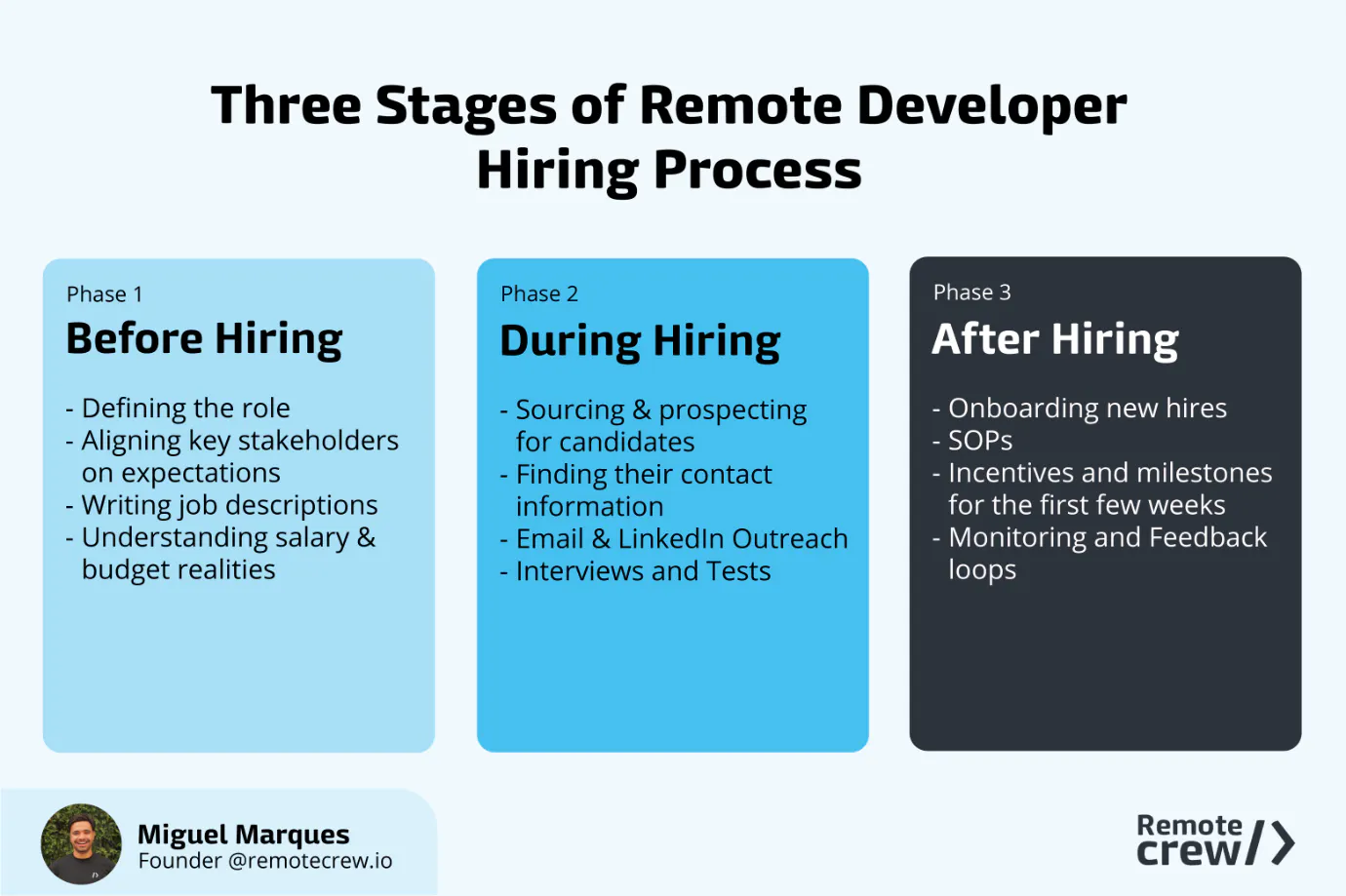
Three Stages of Hiring Java Developers
Hiring Java developers has three stages.
- Pre-hiring covers recruitment planning, understanding seniority levels, salary expectations, and writing compelling job descriptions.
- During hiring, you'll source candidates, conduct framework-specific interviews, and run technical tests.
- Post-hiring handles onboarding, probation evaluation, and retention.
This guide focuses on the first two stages because that's where most hiring failures happen.
Part 1: What You Need to Do Before Hiring Java Developers
Before you post that job description, you need four things nailed down: a clear recruitment plan that specifies your exact technical needs, an understanding of what each seniority level actually means in Spring Boot terms, realistic salary expectations by region, and a job description that filters for the right framework expertise.
Create Your 1-Page Recruitment Plan for Java Developers
- Business problem: "Build microservices REST APIs with Spring Boot 3.x and Java 17 for e-commerce platform serving 200K users" OR "Migrate monolithic Java EE application to Spring Boot microservices" - not "need Java developer"
Technical requirements: - Must-haves: Java version (17 LTS or 21 LTS for modern), framework (Spring Boot 3.x), Spring ecosystem (Spring Data JPA, Spring Security, Spring Cloud for microservices), database (PostgreSQL/MySQL with JPA/Hibernate), containerization (Docker/Kubernetes), testing (JUnit 5, Mockito)
- Nice-to-haves: Cloud platforms (AWS/GCP/Azure), message queues (Kafka, RabbitMQ), Redis caching, monitoring tools (Prometheus, Grafana), CI/CD pipelines
- Why they'd join: Java developers value modern Java versions (17/21, not 8), Spring Boot ecosystem over legacy Java EE, microservices architecture, cloud-native deployment, and solving scalability challenges
Download our free 1-page recruitment plan template adapted for Java specializations.
Understanding Java Developer Seniority Levels
- Junior (1-3 years): Java basics and one framework (Spring Boot OR Java EE), OOP, Spring Boot fundamentals (dependency injection, REST controllers), Spring Data JPA basics, simple SQL, JUnit, Git, implements features with guidance
- Mid (3-5 years): Ships complete features independently, deep Spring Boot knowledge (auto-configuration, Spring profiles), Spring Data JPA optimization (N+1 prevention, query methods, entity relationships), REST API design, Spring Security, testing with JUnit/Mockito, Docker containerization, understands microservices patterns
- Senior (5+ years): Makes architectural decisions (microservices design, database schema, API contracts, service boundaries), complex implementations (distributed systems, service communication, event-driven architecture), deep Spring ecosystem (Spring Cloud, Spring Boot Actuator), performance optimization (JVM tuning, query optimization, caching), Kubernetes deployment, mentors junior developers
Warning: 7 years of "Java experience" could mean 7 years of Android development (not backend), 7 years of Java 8 monoliths (not microservices), or 7 years of Java EE (not Spring Boot). 3 years modern Spring Boot with Java 17+ > 7 years legacy Java EE on Java 8.
Salary Expectations for Java Developers
Java commands market rates because of enterprise adoption across Fortune 500 companies, scalability requirements for high-traffic applications, performance-critical systems, and massive existing codebases requiring maintenance.
Specialization affects rates significantly. Modern Spring Boot developers with Java 17+ command standard backend developer rates. Legacy Java EE maintenance typically pays 10-15% lower due to declining demand. Big Data Java specialists (Spark, Kafka) command 15-25% premiums. Java developers with cloud platform expertise (AWS, GCP, Azure) earn 10-15% more. Developers with Java 17 or 21 experience typically earn 5-10% more than Java 8 developers in the same region.
Region | Junior (1-3 yrs) | Mid-Level (3-5 yrs) | Senior (5+ yrs) | Hourly Rate |
North America | $87,000 | $118,000 | $135,000-$150,000 | $57/hour |
Western Europe | €70,000-€90,000 | €90,000-€110,000 | €110,000-€130,000 | $80-$95/hour |
Eastern Europe | $54,000 | $63,000 | $73,000 | $35-$45/hour |
Latin America | $39,000 | $48,000 | $62,000 | $25-$40/hour |
Remote hiring from Eastern Europe and Latin America offers 40-60% lower rates than North America while maintaining high quality, making it financially attractive for modern Spring Boot talent.
How to Write a Compelling Job Description for Java Developers
- Specify Java version and framework in opening line: "Spring Boot Developer (Java 17+) - Build Microservices REST APIs for E-commerce Platform" OR "Senior Java Developer (Spring Boot 3.x + Kubernetes) - Create Cloud-Native SaaS Application"
- Lead with framework-specific impact: "Architect Spring Boot microservices handling 1M requests/day with PostgreSQL and Redis caching, deployed on Kubernetes"
Must-Have Requirements: - Java 17 LTS or 21 LTS (not "experience with Java")
- Spring Boot 3.x (not "Spring experience")
- Spring ecosystem (Spring Data JPA, Spring Security, Spring Cloud)
- Database (PostgreSQL/MySQL with Hibernate ORM)
- REST API design principles
- Testing frameworks (JUnit 5, Mockito)
- Docker containerization
- Build tools (Maven or Gradle)
Nice-to-Have: - Kubernetes orchestration
- Cloud platforms (AWS/GCP/Azure) with specific services
- Message queues (Kafka, RabbitMQ)
- Redis caching
- Monitoring tools (Prometheus, Grafana)
- Microservices patterns (circuit breakers, API gateways)
- CI/CD pipeline setup
- Fatal mistake: Listing "Java developer" without framework or version. Spring Boot ≠ Java EE, Java 17 ≠ Java 8
- Include salary range - attracts qualified candidates and reduces time-wasters by 60%
Part 2: During Hiring - How to Identify the Best Java Developers
You've defined your Java developer needs, written a framework-specific job description, and set your budget. Now comes the hard part: finding candidates who actually know Spring Boot (not just Java) and can prove it in interviews and technical tests.
How to Source Java Developers on LinkedIn
The concentric circles method works best for Spring Boot developers.
Start your LinkedIn search narrowly with exact requirements: "Java Developer" AND "Spring Boot" AND ("Java 17" OR "Java 21"). Add "Spring Data JPA" to filter for database expertise, include "microservices" to find architecture experience, then apply seniority and location filters.
Reach out to this tier first. Then progressively expand: accept Java 11+ instead of only 17/21, include "Spring Framework" without Boot (transferable skills), broaden experience range by 1-2 years, and expand geography to additional regions.
Target companies known for modern tech stacks - SaaS platforms, fintech companies, cloud-native startups. Avoid companies primarily using Java EE (legacy enterprise). Check candidates' GitHub repositories for Spring Boot projects, microservices implementations, and REST API code quality.
Example outreach message: "Hi [Name], I noticed your experience building Spring Boot microservices at [Company]. We're hiring a Spring Boot Developer (Java 17+) to architect REST APIs for our e-commerce platform serving 200K users. The role involves Spring Data JPA optimization, Kubernetes deployment, and PostgreSQL database design. Salary range: $120-150k + equity. Would you be open to a 15-minute conversation?"
What Questions to Ask During the Interview for a Java Developer Role
Ask framework-specific questions that reveal Spring Boot depth, not generic Java knowledge:
- Explain Spring Boot's dependency injection and auto-configuration. How does component scanning work? Tests Spring Boot fundamentals - should explain @Component, @Service, @Repository annotations, @ComponentScan, and auto-configuration mechanism. Green flag: mentions Spring Boot starters and how @SpringBootApplication works.
- How do you prevent N+1 query problems in Spring Data JPA? Tests JPA knowledge and performance awareness - should explain eager/lazy loading, @EntityGraph, join fetch queries, and query logging. Green flag: mentions Hibernate statistics.
- Walk through designing a RESTful API with Spring Boot for user management. Tests API design skills - should cover HTTP methods, status codes, error handling with @ControllerAdvice, request/response DTOs, validation with @Valid. Green flag: discusses versioning and pagination.
- Explain the difference between @Component, @Service, @Repository, and @Controller in Spring. Tests Spring framework understanding - should explain stereotype annotations, when to use each, and how @Repository provides exception translation. Red flag: says "they're all the same."
- How would you implement JWT authentication in Spring Boot? Tests Spring Security knowledge - should explain JWT token generation/validation, SecurityFilterChain configuration, @PreAuthorize annotations. Green flag: mentions refresh tokens and security best practices.
- Describe your approach to testing Spring Boot applications. Testing practices should cover unit tests with JUnit 5, integration tests with @SpringBootTest, MockMvc for REST controllers, and Testcontainers for database testing. Green flag: mentions test slices like @WebMvcTest.
- How do you handle exceptions globally in Spring Boot REST APIs? Tests exception handling - should explain @ControllerAdvice, @ExceptionHandler, custom exception classes, and standardized error response format. Green flag: discusses HTTP status code mapping.
- Explain how you would implement inter-service communication in microservices. Tests microservices knowledge - should cover synchronous (REST with RestTemplate/WebClient) vs asynchronous (Kafka, RabbitMQ), circuit breakers with Resilience4j, service discovery. Green flag: discusses trade-offs between approaches.
Green Flags vs Red Flags for Java Developers
Evaluation Criteria | Green Flags | Red Flags |
Java Version Knowledge | Discusses Java 17/21 features like records, pattern matching, and virtual threads | Claims "Java is Java" or only knows Java 8 |
Spring Boot Expertise | Explains dependency injection, auto-configuration, and Spring Boot starters | Confuses Spring Boot with Spring Framework or mentions only XML configuration |
Spring Data JPA Depth | Prevents N+1 queries, understands lazy loading, uses @EntityGraph | Doesn't know about the N+1 problem or always uses eager loading |
REST API Design | Proper HTTP methods/status codes, error handling, and pagination | Uses only GET/POST or returns 200 for all responses |
Spring Security Knowledge | Implements JWT authentication, understands SecurityFilterChain, and uses @PreAuthorize | "Security is hard" or hardcodes passwords |
Candidates showing 7+ green flags typically pass probation, with a 95%+ success rate, based on Remote Crew's analysis of 1,500+ interviews.
How to Do Technical Testing for Java Developers
Test under 2 hours:
- Build a simple Spring Boot REST API with 2-3 related entities (User, Order, Product with relationships)
- Requirements: Spring Boot 3.x with Java 17+, Spring Data JPA with entity relationships (@OneToMany/@ManyToOne), REST endpoints with proper HTTP methods, Spring Security for basic authentication, JUnit tests for at least one endpoint
- Evaluate: (1) Spring Boot patterns (proper dependency injection with constructor injection, (2) component structure with @Service/@Controller/@Repository separation), (3) Spring Data JPA relationship implementation (bidirectional relationships, cascade types, fetch strategies), (4) REST API design (appropriate endpoints), (5) proper HTTP status codes, error handling), (6) testing coverage
Alternative tests:
- Provide the existing Spring Boot codebase with the N+1 query problem to solve
- Add a new feature requiring Spring Security authentication
- Implement asynchronous processing with Spring's @Async or message queue
Live coding alternative: 45-60 minutes implementing Spring Boot feature (REST endpoint with JPA, Spring Security configuration)
General guidelines: Provide a Spring Boot starter project (don't make candidates set up from scratch), test Spring Boot-specific patterns, allow access to Spring documentation and Stack Overflow (tests real-world problem-solving), specify Java and Spring Boot versions allowed
Java Developer Skills: Complete Checklist
Modern Spring Boot development requires framework-specific expertise, not just generic Java knowledge. We've found that candidates who check these boxes consistently pass probation with 95%+ success rates.
Must-have skills for modern Spring Boot developers:
- Java 17 LTS or Java 21 LTS with modern features (records, pattern matching, sealed classes, virtual threads)
- Spring Boot 3.x framework expertise (dependency injection, auto-configuration, component scanning)
- Spring Data JPA with Hibernate (entity relationships, query methods, N+1 prevention, lazy vs eager loading)
- REST API design with Spring MVC (proper HTTP methods, status codes, request/response DTOs, validation)
- Spring Security (JWT implementation, role-based access control, BCrypt password encoding)
- Testing with JUnit 5 and Mockito (unit tests, integration tests with @SpringBootTest, MockMvc)
- Maven or Gradle build tools
- Docker containerization and multi-stage builds
- SQL databases (PostgreSQL or MySQL) with complex queries and indexing strategies
- Git version control with branching strategies
Nice-to-have skills that differentiate senior candidates:
- Spring Cloud (API gateway, service discovery, config server)
- Kubernetes orchestration
- Cloud platforms (AWS/GCP/Azure)
- Message queues (Kafka, RabbitMQ)
- Redis caching
- Monitoring tools (Prometheus, Grafana, distributed tracing)
- CI/CD pipelines
- Event-driven architecture patterns
Soft skills critical for remote Java work:
- Clear asynchronous communication about technical architecture
- Self-direction in debugging Spring Boot applications
- Strong documentation habits (README files, API docs, architectural decisions)
- Proactive code review participation
Common Mistakes When Hiring Java Developers
Posting "Java developer" without framework or version specificity wastes 70% of interview time. You'll attract Spring Boot microservices developers, Java EE monolith maintainers, Android developers, and big data engineers - completely different skill sets.
Common mistakes:
- Generic job titles: "Java developer" instead of "Spring Boot Developer (Java 17+)" attracts mismatched specializations
- Ignoring Java versions: Java 8 lacks modern features found in Java 17/21 LTS releases
- Testing algorithms over frameworks: Data structure challenges miss Spring Boot dependency injection, Spring Data JPA, and REST API expertise
- Treating all experience equally: 7 years Android ≠ 7 years Spring Boot; 7 years Java EE ≠ 7 years microservices
- Overlooking Spring ecosystem: Modern development requires Spring Data JPA, Spring Security, Spring Cloud beyond core Java
- Expecting framework transfers: Java EE developers need 3-6 months of retraining for Spring Boot microservices
- Waiting for inbound applications: Best developers are employed and require direct outreach
- Specify "Spring Boot Developer (Java 17+)" to filter correctly from the start.
Java Developer Hiring Checklist
Pre-hiring preparation:
- Define exact specialization: Modern Spring Boot (Java 17+), legacy Java EE, Android, or Big Data
- Specify Java version explicitly: Java 17 LTS, Java 21 LTS, or legacy Java 8/11
- List must-have frameworks: Spring Boot 3.x, Spring Data JPA, Spring Security
- Set salary range based on specialization (modern Spring Boot commands a premium)
- Write framework-specific job description: "Spring Boot Developer (Java 17+)", not "Java developer"
During hiring:
- Source on LinkedIn with specific filters: "Spring Boot" AND ("Java 17" OR "Java 21")
- Verify GitHub repositories for Spring Boot projects and code quality
- Ask 8 framework-specific interview questions testing Spring Boot expertise
- Conduct a 2-hour technical test: Build a Spring Boot REST API with JPA relationships
- Check for 7+ green flags in the evaluation criteria
Post-hiring:
- Onboard with Spring Boot codebase walkthrough and architecture documentation
- Set clear 30/60/90-day expectations with specific deliverables
- Monitor probation performance: code quality, Spring Boot best practices
- Provide feedback on Spring ecosystem usage
Should You Hire Java Developers On-Site or Remote?
We've hired 150+ Java developers both ways, and the data strongly favors remote hiring for most companies - especially when you need modern Spring Boot expertise.
Factor | On-Site Hiring | Remote Hiring | Winner |
Talent Pool Size | 50-100 qualified candidates in a commutable area | 10,000+ Spring Boot developers in Eastern Europe and Latin America alone | Remote |
Cost | $115-150k for mid-senior Spring Boot developer in the US | $54-73k (Eastern Europe), $39-62k (Latin America) for same skill level - 40-60% savings | Remote |
Time to Hire | 4-8 weeks with local candidate scarcity | 1-2 weeks with pre-vetted global candidates, Remote Crew delivers first candidates in 48 hours | Remote |
Spring Boot Expertise | Limited by the local market, many legacy Java EE developers | Access to modern Spring Boot specialists in tech hubs like Portugal, Poland, Brazil | Remote |
Communication | Face-to-face meetings, instant communication | Video calls and async communication require discipline | Tie |
Bottom line: Remote hiring works exceptionally well for Java developers. Strong Java communities thrive in Eastern Europe (Poland, Romania, Bulgaria) and Latin America (Brazil, Mexico, Argentina), with developers who specialize in modern Spring Boot rather than legacy Java EE. Latin America offers excellent timezone alignment for US companies (0-3 hours difference).
Let the Experts Find the Best Java Developers for You
Remote Crew specializes in matching companies with Java developers who have real Spring Boot expertise - not just "Java experience."
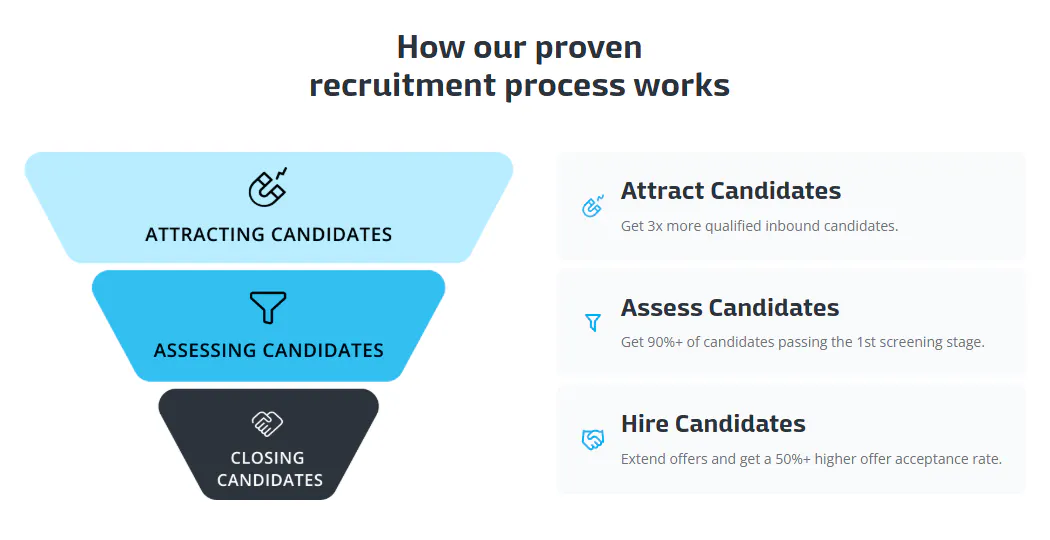
Our framework-specific screening process distinguishes modern Spring Boot developers (Java 17+) from legacy Java EE candidates. We test Spring Data JPA depth and N+1 query prevention, verify Spring Security implementation knowledge, assess microservices architecture understanding, and evaluate hands-on experience with modern Java features like records and pattern matching.
The process moves fast. You get your first qualified candidates within 48 hours through our pre-vetted talent network in Eastern Europe and Latin America. A dedicated technical recruiter with Spring Boot expertise manages everything. You don't pay until you hire.
The results speak for themselves: 99% probation pass rate, 90%+ of our candidates pass client's first technical screening, and 50%+ higher offer acceptance rates compared to traditional recruitment. You access Java talent at 40-60% of US rates while maintaining modern Spring Boot expertise.
Ready to hire? Book a free consultation to discuss your Java needs - Spring Boot vs Java EE specialization, Java version requirements, microservices architecture - and get matched with qualified candidates in 48 hours.
FAQ
What's the difference between Spring Boot and Java EE - does it matter for hiring?
Spring Boot and Java EE are fundamentally different tech stacks despite both using Java. Spring Boot uses microservices architecture with embedded servers, Spring ecosystem dependency injection, cloud-native deployment with Docker/Kubernetes, and modern development patterns. Java EE uses monolithic architecture with application servers like WebLogic/WebSphere, EJB-based dependency injection, traditional deployment models, and older enterprise patterns. A Java EE developer without Spring Boot experience needs 3-6 months of retraining for modern microservices work. Always specify which framework you need in job postings to avoid interviewing the wrong candidates.
Does Java version matter when hiring - Java 17 vs Java 8?
Java version matters critically because the language has evolved significantly between releases. Java 8 LTS, released in 2014, is 10+ years old and lacks modern features. Java 17 LTS (2021) and Java 21 LTS (2023) include records for immutable data, pattern matching for cleaner code, sealed classes for controlled inheritance, and virtual threads for better concurrency. Developers working only on Java 8 without exposure to 11+ miss these productivity improvements. Specify "Java 17+" or "Java 21" in requirements to attract developers with modern language expertise. Three years of Java 17 experience is more valuable than seven years of Java 8 for modern projects.
What's a typical Java developer's salary in 2026?
Java developer salaries vary significantly by region, specialization, and seniority. The United States averages $118k annually ($57/hour) for mid-level, with entry-level at $87k and senior at $135-150k. Spring Boot specialists command a 5-10% premium over generic Java roles. Eastern Europe offers $54-73k annually, Latin America $39-62k, providing 40-60% cost savings versus US rates while maintaining quality. Modern Spring Boot developers with Java 17+ and microservices experience earn more than legacy Java EE developers. Cloud platform expertise (AWS/Azure) adds 10-15% premium. Remote hiring from Eastern Europe or Latin America provides the best value for modern Spring Boot talent.
Spring Boot vs other Java frameworks - which should I hire for?
Spring Boot dominates modern Java backend development with the largest ecosystem, best documentation, and most active community. It's the standard choice for microservices, REST APIs, and cloud-native applications. Alternatives include Java EE/Jakarta EE (legacy enterprise, use only if maintaining existing systems), Micronaut (newer, smaller community, use for specific performance needs), Quarkus (cloud-native focus, growing but smaller talent pool). For 95% of modern Java backend projects, hire Spring Boot developers due to ecosystem maturity, available talent pool, and industry-standard status. Only consider alternatives if you have specific technical requirements that Spring Boot doesn't address.
What's the best country to hire remote Java developers in 2026?
Best countries depend on priorities but top options are: Portugal (strong Java talent, EU timezone, English proficiency, growing tech hub, €40-85k range), Poland (large developer pool, excellent Spring Boot expertise, strong education system, $54-73k range), Brazil (biggest Latin American tech market, timezone alignment with US, Portuguese/English speakers, $39-62k range), Mexico (US timezone alignment, growing tech scene, nearshore advantage for US companies, $40-60k range). Latin America offers the best timezone alignment for US companies (0-3 hour difference). Eastern Europe provides the largest Spring Boot talent pool with strong technical education. Both regions offer 40-60% cost savings versus US rates.
Tech hiring insights in your inbox
From engineers to engineers: helping founders and engineering leaders hire technical talent.
We will only ever send you relevant content. Unsubscribe anytime.