

When hiring remote developers, React.js has become the default choice for building complex, interactive web interfaces: SaaS dashboards, e-commerce platforms, real-time collaboration tools, and admin panels.
But "React developer" on a resume covers a wide range of skills, from someone who completed a tutorial last month to an engineer who understands concurrent rendering, a custom hooks architecture, and performance optimization at scale. Misjudging that gap is expensive.
Europe and Latin America have strong React communities (Lisbon, Warsaw, São Paulo, Buenos Aires) with experienced developers at 40-60% lower rates than US markets and strong timezone overlap. Most companies don't tap these talent pools effectively because they don't know where to look.
At Remote Crew, we've hired 150+ remote developers and interviewed 1,500+ candidates with established networks across both regions. This guide gives you the exact process.
Key Takeaways
- Define your React stack before posting: Align stakeholders on the React version, proficiency with Hooks, TypeScript, and state management, before interviewing anyone.
- Specify concretely: "Build SaaS dashboard with React 18 and Zustand serving 50K daily users," not "improve our frontend"
- Get the founder and tech lead sign-off before posting
- Modern React experience beats resume years: 3 years of Hooks, TypeScript, and performance optimization outperforms 7 years of class components.
- Test current patterns, not legacy class component knowledge
- Outreach beats job boards: Strong React developers in Europe and Latin America respond to targeted outreach, not public postings.
- Target Portuguese fintech, Polish SaaS startups, and Brazilian e-commerce companies
- Personalize: exact stack, concrete challenge, salary range upfront
- Remote hiring cuts costs by 40-60%: Senior developers in Portugal, Poland, and Latin America ($45-75K) versus US rates ($100-150K), with strong time zone overlap.
- Test for architecture thinking, not syntax: Practical tests under 2 hours reveal more than interviews.
- Candidates who explain trade-offs clearly and write clean TypeScript perform best in production
When You Need React.js Developers
- Building modern web applications with complex, dynamic user interfaces requiring component-based architecture
- Single-page applications (SPAs) with sophisticated state management and real-time data updates
- Frontend development for SaaS products with interactive dashboards and admin panels
- E-commerce platforms with dynamic shopping experiences and checkout flows
- Migration projects moving from legacy frameworks (Angular, jQuery, Backbone) to modern React
- Maintaining existing React codebases needing feature additions, performance optimization, or technical debt reduction
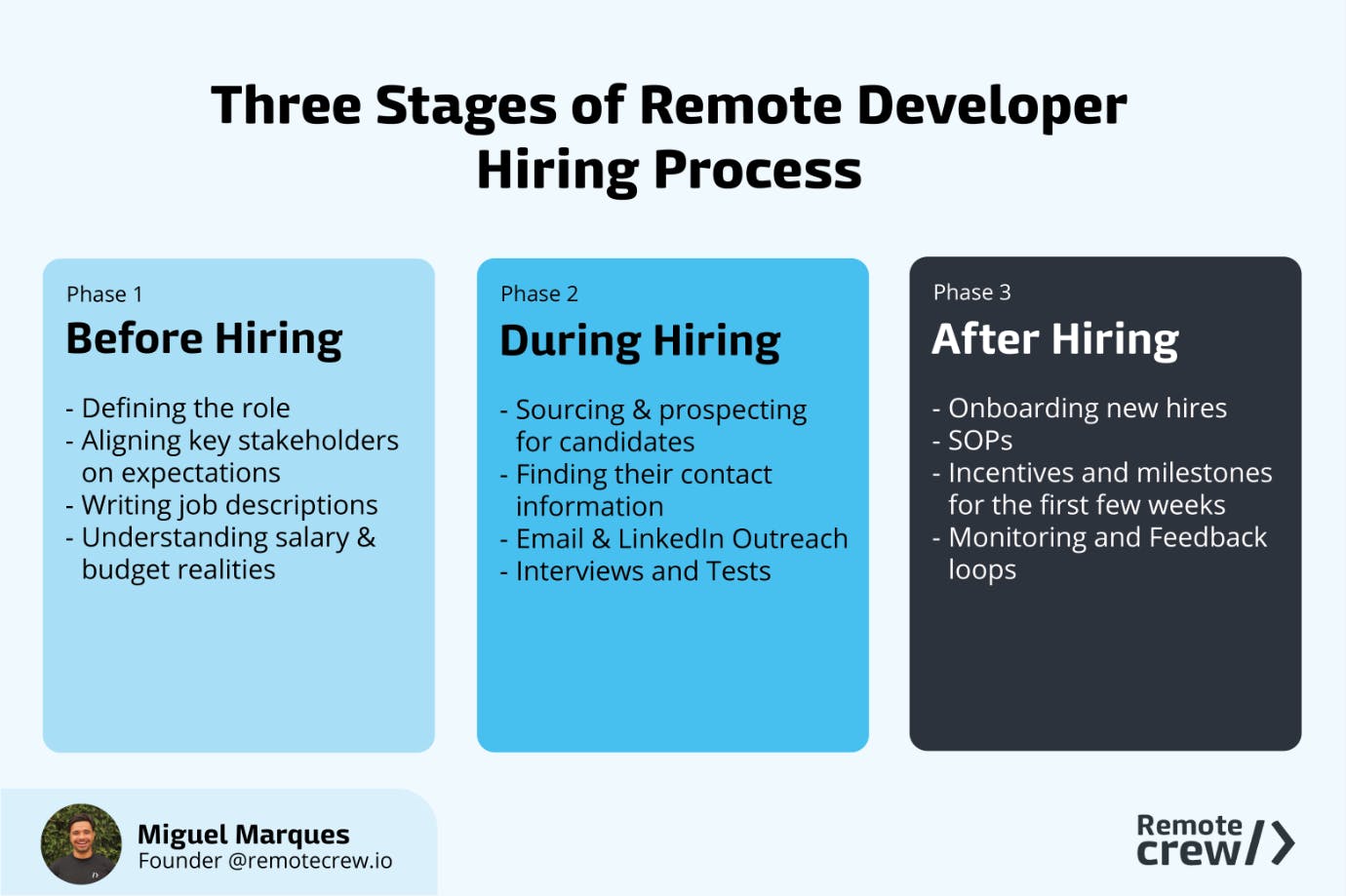
Three Stages of Hiring React.js Developers
Successful React hiring requires three structured phases.
- Phase 1 (Before Hiring) determines 80% of hiring success. Define role requirements, align stakeholders on React version and tech stack needs (TypeScript, Next.js, state management), understand salary realities for target regions, and create candidate-focused job descriptions.
- Phase 2 (During Hiring) focuses on sourcing through targeted outreach, conducting structured React-specific interviews, administering practical tests under 2 hours, and evaluating modern React knowledge versus legacy approaches.
- Phase 3 (After Hiring) covers onboarding with documentation and feedback loops.
This guide focuses only on Phases 1 and 2.
Part 1: What You Need to Do Before Hiring React.js Developers
Most hiring managers jump straight to posting job descriptions and wonder why they spend weeks interviewing candidates who don't match what anyone actually needs. The founder wants one thing, the engineering lead expects another, and nobody documented what "senior React developer" means for your specific situation.
This preparation phase determines 80% of your hiring success before you write a single job post or reach out to a candidate.
Create Your 1-Page Recruitment Plan for React.js Developers
We've found that the best way to prevent wasted interviews is forcing alignment before you start sourcing.
A 1-page recruitment plan stops the disaster where stakeholders disagree on requirements after you've already spent 10 hours interviewing someone.
- Business Problem: Specify the exact React challenge this hire solves. Not "improve our platform" - that tells candidates nothing. Instead: "Build SaaS dashboard with React 18, TypeScript, and Zustand serving 50K daily users" or "Migrate e-commerce checkout from jQuery to React with Next.js SSR, handling 100K monthly transactions."
- Technical Requirements: Differentiate must-haves from nice-to-haves explicitly. Must-haves might include React version (React 17+, React 18+), Hooks proficiency, TypeScript requirement (yes or no), state management approach (Redux, Zustand, Context API), Next.js for SSR needs, and styling methodology (Tailwind, styled-components). Nice-to-haves could be testing expertise, specific libraries, or performance optimization experience.
- Why They'd Join: Answer honestly - why would someone currently working at a competitor leave to join you? Highlight technical challenges they'll own, who they'll work with, learning opportunities, growth path, compensation range, and remote flexibility.
Have the founder, hiring manager, and technical interviewers review this document before posting anything.
Download our free 1-page recruitment plan template to get started faster.
Understanding React.js Seniority Levels (And How They Fit Your Requirements)
- Junior (1-3 years): React fundamentals with Hooks (useState, useEffect), component composition, React Router, API integration, basic CSS styling. They can implement features independently with architectural guidance.
- Mid-Level (3-5 years): Advanced Hooks (useMemo, useCallback, custom hooks), state management libraries (Redux, Zustand), performance optimization, TypeScript integration, Next.js for SSR, Jest and React Testing Library testing, understanding re-render behavior.
- Senior (5+ years): Complex application architecture, advanced state management patterns, micro-frontend implementation, performance profiling across large codebases, mentoring capabilities, evaluating tech stack decisions, legacy codebase migration strategies.
Critical warning: A motivated developer with 3 years of modern React experience - Hooks, TypeScript, performance optimization - will outperform a 7-year developer stuck on class components and Redux boilerplate. Recent hands-on experience with current patterns matters more than resume years.
Salary Expectations for React.js Developers in Europe & Latin America
Understanding salary realities helps you set realistic expectations and budget appropriately.
Hiring from Europe and Latin America provides 40-60% cost savings compared to US markets while maintaining comparable technical quality and superior time zone alignment versus Asian outsourcing.
Region | Junior (Annual) | Mid-Level (Annual) | Senior (Annual) | Hourly Rate (Specialized/Contract) |
United States | $70K-$90K | $90K-$130K | $100K-$150K | $100-$150 |
Western Europe | $48K-$68K | $65K-$95K | $70K-$120K | $70-$115 |
Portugal | $30K-$45K | $42K-$62K | $45K-$75K | $43-$70 |
Poland | $32K-$48K | $45K-$68K | $50K-$80K | $48-$75 |
Romania | $28K-$42K | $40K-$60K | $45K-$75K | $42-$70 |
Latin America | $28K-$42K | $38K-$58K | $40K-$70K | $38-$65 |
Mexico | $30K-$45K | $40K-$60K | $45K-$72K | $40-$68 |
The math is straightforward. You can hire two experienced React developers remotely from Europe or Latin America for the cost of one US-based hire, without sacrificing quality or communication.
How to Write a Compelling Job Description for React.js Developers
Best job descriptions talk about your candidates, not about you or your company's history. For example, "Build our real-time collaboration platform frontend with React 18 and WebSocket integration, serving 50K concurrent users" is better than "We're a Series A SaaS startup founded in 2020".
Specify React version and key technologies (Hooks, TypeScript, Next.js, state management) to filter candidates appropriately. Avoid the common mistake of requiring "React/Angular/Vue experience" - this signals you don't understand what you need.
Include the salary range and mention Europe and Latin America-friendly time zones if targeting these regions. Candidates skip postings without compensation transparency.
Frame your job posting as a career opportunity: a learning path, the people they'll work with, and the technical ownership they'll have.
React.js Job Description Must-Haves:
- Specific React version you're using (e.g., "React 18+" not just "React")
- Hooks requirement clearly stated (required/critical)
- TypeScript requirement (yes/no - be explicit)
- State management approach (Redux, Zustand, Context API)
- SSR needs if applicable (Next.js experience required/nice-to-have)
- Styling methodology (Tailwind, styled-components, CSS Modules)
- Testing framework and expectations (Jest, React Testing Library, coverage requirements)
- Team structure: who they'll work with and learn from
- Salary range or "Competitive salary" with specific equity details
- Red flag to avoid: Never list "React/Angular/Vue" together - shows a lack of clarity on what you need
Part 2: How to Identify the Best React.js Developers
The best React developers don't browse job boards. They respond to targeted outreach when you demonstrate you understand their work and offer something worth their time. This section shows you how to find them in Europe and Latin America's tech hubs, evaluate their skills, and avoid expensive hiring mistakes.
How to Source React.js Developers in Europe & Latin America on LinkedIn
We've found that the concentric circles approach works best when building candidate lists on LinkedIn.
Start narrow with your ideal criteria - React 18+, TypeScript, Next.js, 5+ years, located in your target city. Reach out to this tier first. Then progressively relax requirements to expand your pool without burying strong candidates in massive lists.
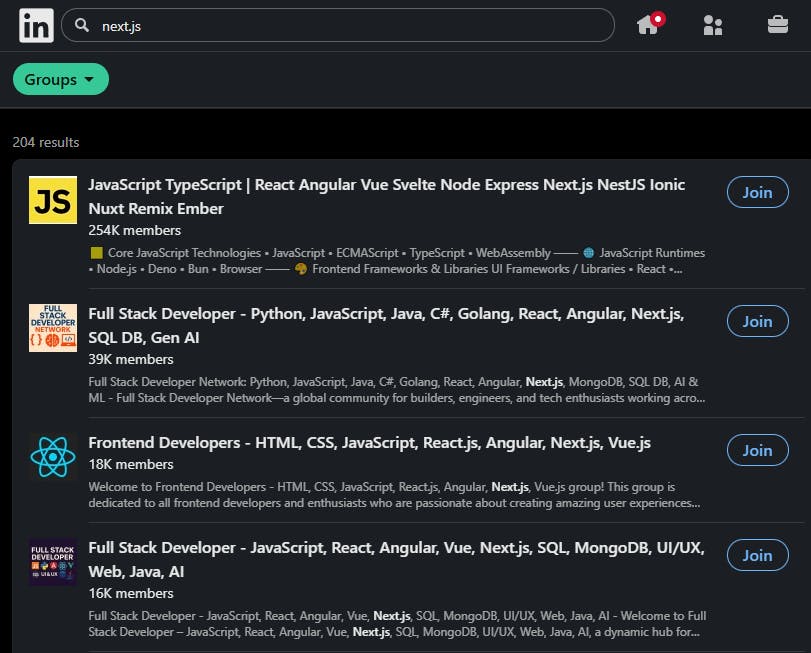
Target companies known for React development in these regions: Portuguese fintech companies, Polish SaaS startups, Brazilian e-commerce platforms, and Argentine software consultancies building React products. Check GitHub repositories for React contributions, personal projects using modern patterns, and open-source library maintenance showing continued ecosystem engagement.
Your outreach message must stay under 300 characters on LinkedIn. Include the specific React version you're using, state your compensation range, explain a concrete technical challenge, and make response effortless with a calendar link.
Here's what works: "Hi Maria - saw your work on the e-commerce checkout migration to React 18 at [Company]. We're building similar architecture (React 18, Next.js, TypeScript, 100K monthly transactions) and need someone who understands SSR at scale. $65-85K, fully remote, Europe-friendly hours. Worth a quick chat? [calendar link]"
What Questions to Ask During the Interview for a React.js Developer Role
Ask questions that generate technical discussion rather than right/wrong answers. You're assessing depth of knowledge and problem-solving approach.
- React Hooks understanding: "Explain React Hooks and when you would use useEffect versus useLayoutEffect." This tests modern React knowledge and understanding of rendering behavior. Strong candidates discuss effect timing, DOM mutations, and visual updates.
- Performance optimization: "How do you optimize React performance? Discuss React.memo, useMemo, and useCallback." Look for explanations of unnecessary re-renders, memoization trade-offs, and when optimization adds complexity without benefit.
- State management judgment: "Explain your approach to state management. When would you use Context API versus Redux versus Zustand?" Great answers include scale considerations, team size factors, debugging needs, and boilerplate trade-offs.
- Next.js and rendering strategies: "What's the difference between client-side rendering, SSR, and SSG in Next.js?" Strong candidates explain use cases for each, performance implications, and SEO considerations.
- Form handling: "How do you handle forms in React? Controlled versus uncontrolled components." Look for understanding of form libraries like React Hook Form or Formik, validation patterns, and performance with large forms.
- TypeScript integration: "Explain your TypeScript usage in React projects." Strong candidates discuss prop typing, generic components, avoiding 'any' type, and gradual TypeScript adoption strategies.
Green Flags vs Red Flags for React.js Developers
Category | Green Flags | Red Flags |
Modern React Knowledge | Discusses useEffect dependency arrays and cleanup functions, explains custom Hooks patterns | Only knows class components, unfamiliar with Hooks API |
Performance Optimization | Explains React.memo use cases, discusses useMemo and useCallback appropriately | Memoizes everything without understanding cost, unaware of React DevTools Profiler |
State Management | Discusses trade-offs between solutions, matches complexity to need | Suggests Redux for every project, unfamiliar with alternatives |
TypeScript Proficiency | Uses interfaces and generics properly, avoids 'any' type | Heavy use of 'any', doesn't leverage type system benefits |
Next.js/SSR Experience | Explains SSR versus SSG use cases, understands routing | Confuses Next.js with Create React App, unaware of rendering strategies |
Candidates showing 7+ green flags typically pass probation with a 95%+ success rate based on Remote Crew placement data.
How to Do Technical Testing for React.js Developers
Keep tests under 2 hours with starter templates.
Sample project ideas:
- Build a product list with pagination and filtering using Hooks
- Create a form with validation using React Hook Form
- Implement a real-time dashboard with data fetching
Evaluate component architecture, Hooks usage quality, state management approach, TypeScript discipline if required, performance awareness, and testing coverage.
Provide a starter template with basic React setup, TypeScript if needed, and a testing framework configured.
If you're concerned about AI assistance, run a 45-minute live coding session instead. Watch them work in real-time and ask them to explain their choices as they code.
React.js Developer Skills - Complete Checklist
When evaluating React developers from Europe and Latin America, separate must-haves from nice-to-haves to avoid filtering out strong candidates who lack secondary skills.
Must-have technical skills:
- Modern React with Hooks (useState, useEffect, useContext, useCallback, useMemo, custom hooks)
- Component architecture and composition patterns
- JavaScript ES6+ proficiency (destructuring, async/await, modules)
- TypeScript integration if your codebase uses it
- State management approach (Redux, Zustand, Context API, or component-level)
- React Router for navigation
- API integration and data fetching patterns
- Styling methodology (Tailwind, styled-components, CSS Modules)
- Testing with Jest and React Testing Library
- Git version control
Nice-to-have skills:
- Next.js for SSR and static generation
- Performance optimization techniques
- React Server Components (React 18+)
- GraphQL and Apollo Client
- Form libraries (React Hook Form, Formik)
- Build tools configuration (Vite, Webpack)
Critical remote work skills:
- Async communication clarity
- Self-direction and autonomous problem-solving
- Strong documentation habits
- Proactive communication about blockers
Common Mistakes When Hiring React.js Developers
After analyzing 1,500+ React developer interviews, these mistakes consistently derail hiring processes and waste weeks on misaligned candidates.
- Confusing React with React Native in job postings. These are different technologies. React builds web applications, React Native builds mobile apps. Mixing them signals you don't understand your own requirements and filters out qualified candidates who know exactly which one you need.
- Not specifying Hooks requirements explicitly. Developers comfortable with modern React (Hooks, functional components) work differently from those stuck on legacy class components. If your codebase uses Hooks, say so upfront.
- Ignoring TypeScript when your codebase uses it. Testing for React without TypeScript when your entire codebase requires it wastes everyone's time. Specify it in the job description.
- Testing with outdated class component questions. If you're assessing class component knowledge when you've been using Hooks for years, you're filtering for the wrong skillset.
- Overlooking Next.js experience when SSR is needed. Server-side rendering requires specific expertise beyond basic React.
- Not considering geographic time zone advantages. Europe offers 5-8 hour overlap with US East Coast; Latin America provides near-complete alignment for real-time collaboration.
React.js Developer Hiring Checklist
After analyzing 1,500+ interviews, here's what actually works when hiring React developers from Europe and Latin America. Skip any step and you risk extending your timeline by weeks.
Before Hiring:
- Create 1-page recruitment plan defining React version, TypeScript requirement, state management approach, Next.js needs
- Set realistic budget using regional salary data for Europe and Latin America
- Write candidate-focused job description with salary range and remote work details
- Define seniority level (junior/mid/senior) with specific skill expectations
Sourcing:
- Search LinkedIn with "React" + "Hooks" + "TypeScript" filters for modern developers
- Target tech companies in Portugal, Poland, Romania, Brazil, Argentina, Mexico
- Send personalized outreach under 300 characters explaining specific technical challenge
- Leverage Remote Crew's pre-vetted networks in Lisbon, Warsaw, São Paulo, Buenos Aires
Assessment:
- Use structured interview questions consistently across all candidates
- Test React Hooks proficiency, performance optimization understanding, state management judgment
- Evaluate TypeScript discipline if relevant to role
- Administer practical tests under 2 hours with starter templates
Evaluation:
- Assess motivation alongside technical capability - excited developers with 3-4 years outperform burned-out veterans
- Green flags: discusses trade-offs, explains thinking process, asks clarifying questions
- Red flags: cannot explain technical choices, defensive when probed, only knows one approach
Closing:
- Move quickly, aim to meet 4-5 qualified candidates before deciding
- Extend offers with clear compensation structure and growth path
Should You Hire React.js Developers On-Site or Remote?
Remote hiring from Europe and Latin America delivers three advantages on-site hiring can't match: access to 100x more React specialists, 40-60% cost savings, and faster time to first candidates.
Here's how the approaches compare across key criteria:
Criteria | Remote (Europe/LatAm) | On-Site (US) | Why It Matters |
Talent Pool Size | Global (millions) | Local (thousands) | 100x more candidates to choose from |
Time to Hire | 48 hours to first candidates | 2-4 weeks minimum | Faster hiring means faster shipping |
Cost Range (Senior) | Europe $45-80K / LatAm $40-70K | US $100-150K | 2x the team at same budget or significant savings |
React Specialists | High availability globally | Limited by local market | Access niche Next.js and TypeScript expertise easily |
Time Zone Overlap | Europe 5-8 hours / LatAm near-complete | Same timezone only | Real-time collaboration when needed |
Infrastructure Costs | Minimal (remote setup) | $3-7K per seat annually | Significant overhead savings |
Cultural Alignment | Strong with US/Canada | Native alignment | European and LatAm work ethics align well |
Bottom line: Remote hiring from Europe and Latin America wins for 80% of React projects. You'll build stronger teams faster at half the cost without sacrificing quality or collaboration.
Let Remote Crew Find Your React.js Developers in Europe & Latin America
Remote Crew specializes in placing React developers from pre-vetted networks across Europe and Latin America, using a methodology refined through 150+ successful placements with a 99% probation pass rate.
Our technical screening covers what internal HR teams typically miss: Hooks assessment, performance optimization evaluation, state management judgment, TypeScript proficiency validation, and architecture thinking. We filter for modern React expertise, not just "React" on a resume.
Geographic advantage delivers first qualified candidates within 48 hours from established tech hubs - Portugal (Lisbon), Poland (Warsaw, Kraków), Romania (Bucharest), Brazil (São Paulo), Argentina (Buenos Aires), Mexico (Mexico City). No weeks of manual sourcing or cold outreach.
Time zone optimization matters. European candidates provide 5-8 hour workday overlap with US East Coast. Latin American candidates offer near-complete time zone alignment for real-time collaboration and daily standups.
The model is risk-free: we start working on your role without upfront fees. You only pay when a candidate is placed and starts work.
Book a free consultation to access pre-vetted React developers from Europe and Latin America tech communities.
FAQ
Why hire React developers from Europe and Latin America specifically?
Europe and Latin America offer 40-60% cost savings versus the US markets without quality compromise. Senior developers cost $45-75K versus $100-150K in the US. You get superior time zone overlap compared to Asian outsourcing - Europe provides 5-8 hour workday alignment, Latin America offers near-complete US time zone matching. These regions have vibrant React tech communities in cities like Lisbon, Warsaw, and São Paulo, with high English proficiency and cultural work ethics that align with North American company expectations.
How much should I pay a React developer from these regions in 2026?
Portugal senior React developers cost $45-75K annually, Poland $50-80K, Romania $45-75K, Brazil and Argentina $40-70K, Mexico $45-72K, compared to the US baseline of $100-150K. TypeScript and Next.js expertise adds 10-15% premium. These rates represent full-time employment, not contractor hourly. Remote Crew provides current market data during consultation. The quality remains comparable at significantly lower cost, letting you hire two experienced developers for the price of one US-based hire.
What is the time zone difference, and does it affect collaboration?
Lisbon operates on GMT (5 hours ahead of EST, 8 hours ahead of PST), Warsaw on CET (6 hours ahead of EST), Brazil matches EST exactly, Argentina is one hour ahead of EST, and Mexico aligns with CST. European developers provide 5-8 hour workday overlap sufficient for daily standups and real-time problem-solving. Latin American developers offer a near-complete overlap, enabling full-day collaboration. This contrasts sharply with Asian outsourcing, creating 12+ hour gaps, forcing async-only workflows.
How do I verify a React developer knows modern React (Hooks) versus legacy approaches?
Ask specific technical questions about useEffect dependency arrays and cleanup functions. Request examples of custom Hooks they've built. Probe their understanding of useMemo and useCallback use cases. Check if they discuss React 18+ features like concurrent rendering. Review their GitHub for recent projects using Hooks-based code. Administer practical tests requiring Hooks implementation. Watch for red flags like suggesting class components or unfamiliarity with functional component patterns. Remote Crew's technical screening validates modern React knowledge before candidate introduction.
How long does it take to hire a qualified React developer from these regions?
With Remote Crew's pre-vetted networks, the first qualified candidates appear within 48 hours. Typical timeline spans 4-6 weeks from role definition to start date: preparation phase (3-5 days), sourcing phase (first responses in 48 hours), screening and interviews (1-2 weeks), technical testing and evaluation (1 week), offer and onboarding (1-2 weeks including notice period). Traditional hiring without structure takes 12-16 weeks. Established regional networks eliminate weeks of manual sourcing and screening unqualified candidates.
Tech hiring insights in your inbox
From engineers to engineers: helping founders and engineering leaders hire technical talent.
We will only ever send you relevant content. Unsubscribe anytime.