

"Full stack developer" means something completely different at every company. This guide shows how to hire remote developers ("full stack" to be exact) specifically for your company. Others want DevOps + frontend + backend + database generalists. Most job descriptions use the term without defining what it actually means for their team.
The consequence? Companies waste weeks interviewing candidates who look perfect on paper but fail because expectations were never aligned. A candidate rejected by one stakeholder would've been perfect for another, but nobody documented what "full stack" actually meant.
At Remote Crew, we've hired 150+ remote developers and interviewed 1,500+ candidates across every role. Here's what separates successful placements from failed ones: 80% of full-stack hiring failures happen before the first interview, in the definition phase.
This guide shows how to define "full stack" specifically for your company, choose between T-shaped vs generalist developers, and structure hiring to get first candidates in 48 hours.
Key Takeaways: Hiring Full Stack Developers in 2026.
- Define your exact tech stack before posting: Specify MERN, MEAN, Django, or .NET upfront and clarify depth expectations.
- State explicitly: "React expert who can build Node.js APIs," not "equal expertise in frontend and backend"
- T-shaped developers (deep in one area + functional in others) are more realistic than true generalists
- Get the founder and tech lead sign-off before posting to prevent interviewing misaligned candidates
- Full-stack works for specific scenarios: Startups shipping MVPs, feature teams owning UI-to-database, small teams under 20 engineers where coordination costs outweigh specialist benefits.
- Seniority reflects depth, even more than years: Junior (1-3 years) strong in one layer, Mid (3-5 years) builds end-to-end independently, Senior (5+ years) designs architecture across the stack.
- Outreach beats job boards: Strong full-stack developers respond to targeted outreach, not public postings.
- Target startups and product companies using your stack
- Personalize: specific project noticed, concrete technical challenge, salary range upfront
- Remote hiring cuts costs 40-60%: Senior developers in Portugal, Eastern Europe, and Latin America ($55-85K) versus US rates ($110-160K).
- Test for architecture thinking: Practical tests under 2 hours (CRUD app with React + Express + database) reveal more than interviews.
When Do You Need Full Stack Developers?
- Building web applications requiring both frontend and backend development
- Startups and small teams needing developers who can work across the entire stack
- MVP development where speed matters more than specialization
- Feature teams owning complete functionality from UI to database
- Maintaining existing full-stack applications (MERN, MEAN, Django, .NET stacks)
- Projects with tight budgets requiring versatile developers who ship independently
Defining "Full Stack" for Your Company
The term "full stack developer" spans everything from someone who touched both frontend and backend once to true experts across all layers.
Most companies waste weeks interviewing misaligned candidates because they never defined what "full stack" actually means for their team.
Specify Your Actual Tech Stack
Start by naming your exact stack. The five most common combinations are:
- MERN Stack (MongoDB, Express, React, Node.js): JavaScript/TypeScript across the entire stack, fastest for startups prioritizing rapid development. TypeScript is considered mandatory for professional MERN development in 2026.
- MEAN Stack (MongoDB, Express, Angular, Node.js): Angular instead of React, better for enterprise applications
- Django Stack (Python, Django/Flask, React/Vue, PostgreSQL): Python backend with JavaScript frontend
- .NET Stack (C#, .NET Core, SQL Server, React/Angular): Microsoft ecosystem, common in enterprises
- LAMP Stack (Linux, Apache, MySQL, PHP): Legacy but still common in existing applications
This specificity prevents qualified Java candidates from applying to your Node.js role.
Define Depth vs Breadth Requirements
Be realistic about what you actually need:
- T-shaped developers have deep expertise in one area (frontend OR backend) plus functional capability in others. This is what most companies actually need - a React expert who can build Node.js APIs and write basic SQL queries.
- True generalists offer moderate depth across frontend, backend, databases, and DevOps. They're rare, expensive, and often deliver mediocre implementation across all layers.
- Specialists claiming to be full-stack are backend developers with basic HTML skills. They're common and problematic - they can't actually ship frontend features.
Define your primary need explicitly: "React expert who can build Node.js APIs" versus secondary capabilities like "basic PostgreSQL queries, can deploy to Vercel."
Three Stages of Hiring Full Stack Developers
Most companies jump to interviews and waste months on mediocre hires. Successful hiring requires three phases.
- Phase 1 (Before Hiring) - determines 80% of success. Define your exact tech stack, align stakeholders on depth versus breadth, understand salary realities, and write candidate-focused descriptions.
- Phase 2 (During Hiring) - means reaching out to A players through LinkedIn's concentric circles method, structured interviews, and under-2-hour tests covering both sides.
- Phase 3 (After Hiring) - covers onboarding with SOPs and 60-day expectations.
This guide focuses on phases 1 and 2.
Part 1: What You Need to Do Before Hiring Full Stack Developers
This phase determines 80% of your hiring success before you write a single job post.
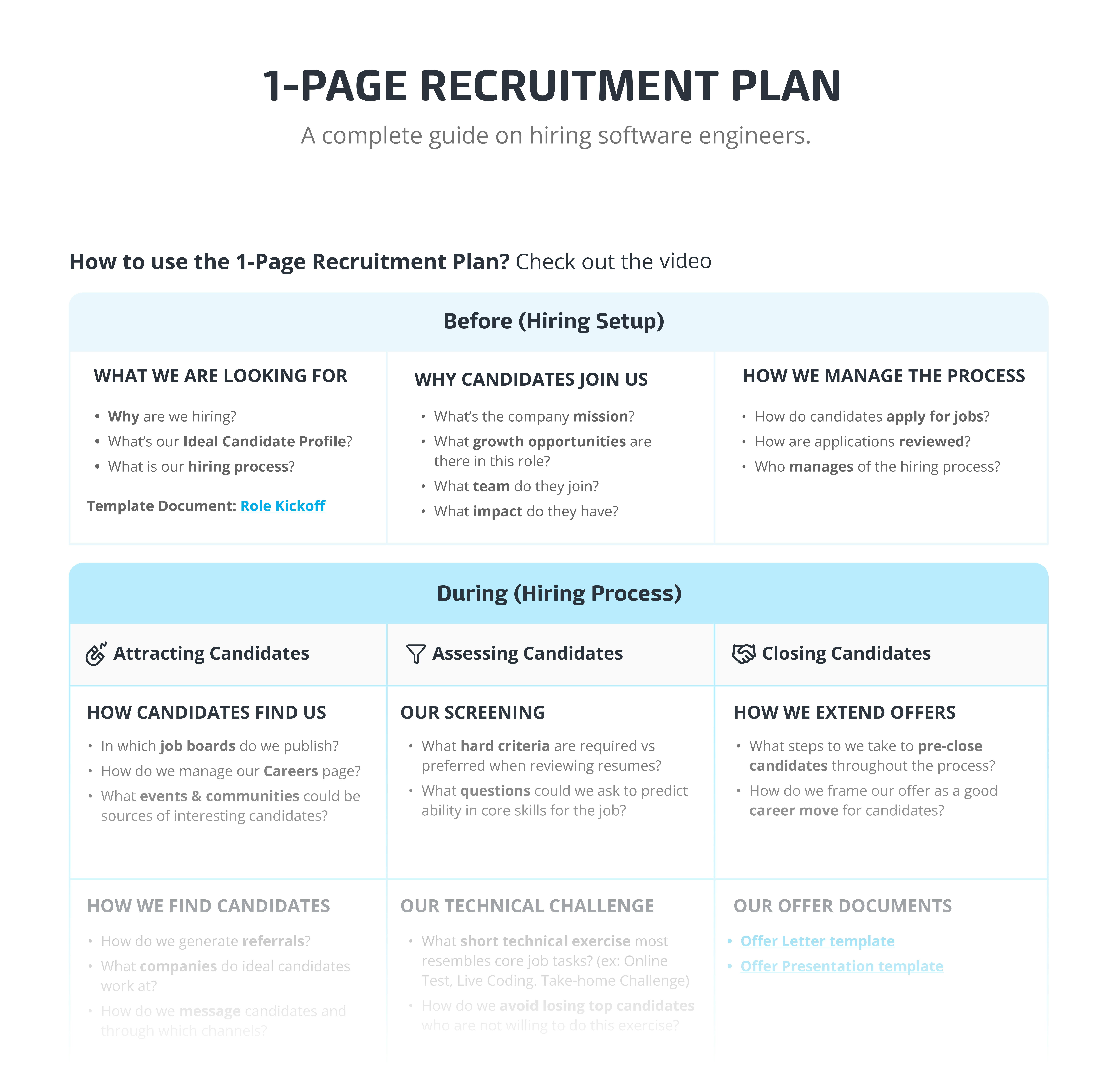
Create Your 1-Page Recruitment Plan for Full Stack Developers
A 1-page recruitment plan forces alignment before you waste time interviewing candidates who would satisfy one stakeholder but frustrate another. After analyzing 1,500+ interviews, we've found that three sections make the difference:
- Business Problem (150-200 words): Specify the exact challenge this hire will solve. Not "improve our platform" - that means nothing. Instead: "Rebuild authentication for 100K daily users with React + Node.js + PostgreSQL" or "Build scheduling platform serving 50K appointments monthly."
- Technical Requirements: Separate must-haves from nice-to-haves explicitly. Must-haves might include React, Node.js, PostgreSQL, TypeScript, and REST API experience. Nice-to-haves could be GraphQL, Docker, or AWS knowledge.
- Why They'd Join: Include compensation range, end-to-end ownership opportunities, learning potential, and growth path (like "tech lead within 12-18 months"). If you can't answer convincingly why someone at a competitor would join you, you'll struggle to close strong candidates.
Get your founder, hiring manager, and technical interviewers to sign off on this document before posting anything. Resolve disagreements now, not during interviews.
Download a free 1-page recruitment plan template to kick-start the process.
Understanding Full Stack Developer Seniority Levels
Seniority means different things at different companies, so define it explicitly for your team.
- Junior (1-3 years): Strong in one layer (frontend OR backend), learning the other. Can build basic CRUD apps, integrate APIs, write basic SQL, and use Git. They need guidance on architecture decisions, but execute well with direction.
- Mid-level (3-5 years): Competent in both frontend and backend. Builds features end-to-end independently, designs APIs, creates database schemas, implements authentication, and handles basic deployment. This is your workhorse level.
- Senior (5+ years): Designs architecture across the entire stack. Optimizes performance on both frontend and backend, handles database optimization, manages DevOps processes, implements security, and mentors junior developers.
Here's the critical insight we've seen repeatedly: a motivated 3-year developer with strong React + Node.js who's shipped apps outperforms a burned-out 7-year developer with shallow knowledge across too many technologies. Depth in your primary stack plus motivation predicts success better than years of experience.
Salary Expectations for Full Stack Developers
Full-stack developers command a premium because their versatility reduces coordination overhead. They're valuable for startups and small teams since they ship complete features independently without constant handoffs between specialists.
Here's what you can expect to pay in 2026:
Region | Junior | Mid-Level | Senior | Hourly Rate |
North America | $80-125K | $115-162K | $145-200K | $100-150/hr |
Western Europe | $60-95K | $85-130K | $115-165K | $80-120/hr |
Eastern Europe | $40-65K | $55-90K | $75-120K | $50-80/hr |
Portugal | $38-60K | $52-85K | $70-110K | $45-75/hr |
Latin America | $35-55K | $50-80K | $65-105K | $40-70/hr |
MERN and MEAN developers (JavaScript across the full stack) command a slight premium due to JavaScript's ubiquity. The remote hiring advantage is significant - Eastern Europe and Latin America offer comparable talent at 40-60% of US rates. That means you can either get the same quality at half the cost OR double your team at the same budget.
How to Write a Compelling Job Description for Full Stack Developers
- Lead with impact and your specific stack: "Build scheduling platform with React + Node.js + PostgreSQL serving 50K appointments monthly" beats "Join our growing team."
- Specify your exact stack in the first paragraph: Frontend framework (React/Angular/Vue), backend framework (Node.js/Express/Django), database (PostgreSQL/MongoDB), and key technologies (TypeScript, REST APIs, Docker). This filters candidates appropriately and attracts developers who actually want to work with your stack.
- The fatal mistake: Requiring "proficient in React, Angular, Vue, Node.js, Python, Java." This signals unclear requirements and scares away strong candidates. Pick ONE stack. Depth beats breadth.
- Clarify your depth expectation explicitly: "React expert with Node.js capability" versus "equal frontend/backend depth" versus "backend-focused with React UI skills." This prevents misaligned applications.
- Include your salary range: In 2026, transparency dramatically improves application quality because candidates self-select appropriately. You waste less time on people outside your budget.
- Your job description checklist should cover: (1) Specific stack (MERN/MEAN/Django/.NET), (2) primary strength area, (3) TypeScript requirement, (4) database expectations, (5) API design capability, (6) DevOps level needed, (7) remote work details, and (8) salary range.
- Never list 5+ different stacks as interchangeable: Like "React OR Angular OR Vue, Node.js OR Python OR Java"). It shows you don't know what you need, and top candidates avoid unclear roles.
Part 2: During Hiring - How to Identify the Best Full Stack Developers
Most companies post full stack roles and wait for applications. That's backwards. The best full stack developers aren't browsing job boards - they're responding to targeted outreach from recruiters who've done their homework. If you're waiting for inbound applications, your competitors are already talking to the candidates you need.
How to Source Full Stack Developers on LinkedIn
We've tried many different ways to find and reach ideal candidates, and the concentric circles method works best. It prevents strong candidates from getting buried in massive lists you never reach due to time constraints.
Start narrow with your specific stack. Search for "React" AND "Node.js" (use your actual stack), add TypeScript, set seniority level, filter by location or time zone, and look for the "open to work" badge. Reach out to this tier first, then progressively expand.
Expand your search by relaxing the criteria gradually. Try alternative frontend frameworks, increase the experience range, include adjacent stacks (MEAN if you're seeking MERN), and broaden geographic regions. This systematic expansion ensures you contact the best-fit candidates before settling for acceptable ones.
Target the right companies. Startups and product companies produce developers who ship end-to-end features. Agencies typically produce narrow specialists who've worked on fragments of projects. Check GitHub profiles for full-stack projects showing both frontend and backend code - React components plus Express APIs plus database schemas prove real capability.
Your outreach message must be under 300 characters for LinkedIn. Include specific full-stack work you noticed, a concrete technical challenge, and a salary range.
Example: "Hi Maria - saw your payment dashboard work at Stripe using React + Node.js. We're building similar real-time features for cross-border payroll serving 50K users. $120-150K + equity, fully remote. Your WebSocket experience would be directly relevant. Worth a quick chat?"
What Questions to Ask During the Interview for a Full Stack Developer Role
Strong interview questions generate technical discussion that reveals depth, not just right or wrong answers. Here's what works:
- "Walk through a user request flow from frontend to database and back" - Tests full-stack architecture understanding. Strong candidates explain button click → React handler → API call → Express route → database query → response → state update → UI re-render.
- "Structure a REST API for \\\[specific use case\\\]" - Tests backend API design. Look for endpoint structure, HTTP methods, request/response formats, error handling, and authentication discussion.
- "Explain authentication and authorization across the stack" - Tests security understanding from frontend to backend. Should cover JWT tokens, secure browser storage, protected React routes, Express middleware validation, and role-based access.
- "Describe your state management approach in frontend apps" - Tests frontend depth. Strong candidates compare Context API, Redux, and Zustand while explaining trade-offs.
- "How do you optimize database queries and prevent N+1 problems?" - Tests database knowledge. Look for indexing strategies, query optimization, ORM awareness, and performance issue understanding.
- "What logic belongs in frontend vs backend?" - Tests architectural judgment. Strong candidates discuss security (backend), user experience (frontend), data validation (both), and business rules (backend).
Green Flags vs Red Flags for Full Stack Developers
Category | Green Flags | Red Flags |
Stack Understanding | Explains frontend-backend connection clearly, traces request flows | Vague about how layers connect, can't explain API contracts |
Depth Balance | Deep in one area + functional in other, honest about strengths | Claims equal expertise everywhere, defensive about gaps |
Full-Stack Projects | Examples of end-to-end features shipped, describes both UI and API work | Only frontend or backend examples, unclear individual contribution |
API Design | Discusses REST principles, error handling, versioning | Basic CRUD only, no error handling |
Database Knowledge | Schema design reasoning, understands indexes and queries | Superficial SQL, can't explain normalization |
Candidates showing 7+ green flags typically pass probation with 95%+ success rate based on our placement data.
How to Do Technical Testing for Full Stack Developers
Keep tests under 2 hours with a starter template provided (your stack configured). Longer tests filter out candidates with options.
Sample project ideas mirroring real full-stack work:
- Build a simple CRUD app with React + Express + database (users can create, read, update, delete items)
- Implement authentication flow (signup/login with JWT, protected routes on frontend and backend)
- Create a REST API with 3-4 endpoints plus a React UI consuming it (e.g., a todo list with add, complete, and delete)
Evaluate: (1) full-stack architecture (separation of concerns), (2) API design (RESTful conventions, error handling, status codes), (3) frontend code organization (component structure, state management), (4) database schema (normalization, data types), (5) error handling across stack (frontend validation, backend validation), (6) authentication implementation (secure token storage, protected routes), and (7) code quality on both frontend and backend.
Live coding alternative: If concerned about AI assistance, conduct 45-60 minute live coding session where you watch them work in real-time.
Modern developers use AI tools in their daily work. Focus on whether they can explain their choices and reasoning, not whether they used assistance.
Full Stack Developer Skills - Complete Checklist
Use this checklist during candidate evaluation to assess technical depth and remote work readiness.
Must-Have Technical Skills
- Frontend: HTML5/CSS3, modern JavaScript (ES6+), one framework (React/Angular/Vue), component architecture, state management, responsive design, browser debugging
- Backend: One stack (Node.js + Express, Python + Django, or C# + .NET), REST API design, authentication (JWT/OAuth), server validation, async operations, middleware patterns
- Database: SQL or NoSQL matching your stack, schema design, query optimization, migrations, ORM/ODM usage, relationship modeling
- Core Tools: Git (branching/merging/PRs), npm/yarn, cross-stack debugging, environment configuration
- Concepts: API integration, authentication flows, data flow across layers, security basics (XSS/CSRF/SQL injection), request/response lifecycle
Nice-to-Have Skills
- TypeScript (becoming mandatory in 2026)
- GraphQL
- Docker
- CI/CD pipelines
- Cloud platforms (AWS/GCP/Azure)
- Testing frameworks (Jest/Mocha/Cypress)
- WebSocket/real-time features
- Microservices awareness
- Advanced DevOps
Critical Soft Skills for Remote Full-Stack Work
- End-to-end ownership mindset
- Clear communication across technical domains
- Self-direction and autonomy
- Strong async written communication
- Problem-solving across layers
Common Mistakes When Hiring Full Stack Developers
After interviewing 1,500+ developers, these mistakes consistently derail full-stack hiring:
- Posting "full stack developer" without specifying your exact tech stack. Attracts candidates with random skill combinations. Specify MERN, MEAN, Django, or .NET explicitly in job postings.
- Expecting equal expertise across frontend, backend, databases, and DevOps. Unrealistic for most developers and produces mediocre results. Hire T-shaped developers - deep in one area with functional capability in others. Define whether you need frontend-leaning, backend-leaning, or truly balanced.
- Testing only frontend or only backend skills when role requires both. Test end-to-end feature implementation. Candidates might know React and Node.js separately but fail when connecting them.
- Not clarifying depth expectations upfront. "React expert who can build Node.js APIs" differs from "equal frontend/backend capability." Under-specify and you'll reject candidates for unwritten expectations.
- Requiring proficiency in 5+ different technology stacks as if interchangeable (e.g., "React OR Angular OR Vue, Node.js OR Python OR Java"). Shows you don't understand what you need.
- Ignoring the importance of understanding how the frontend and backend connect. Candidates must explain API contracts, authentication flows, and data flow across layers.
- Hiring generalists with shallow knowledge everywhere instead of T-shaped developers with real depth in one area.
- Not assessing end-to-end project experience. Building isolated frontend or backend pieces differs entirely from full-stack ownership.
- Skipping the 1-page recruitment plan and jumping straight to interviewing. Leads to rejecting candidates for conflicting expectations that nobody documented.
- Waiting for inbound applications instead of targeted outreach. Best full-stack developers respond to personalized outreach, not job boards.
Full Stack Developer Hiring Checklist
After analyzing 1,500+ interviews, here's what works when hiring full stack developers. Skip any step, and you risk weeks of delays or the wrong hire.
Before You Start Hiring
- Create 1-page recruitment plan: business problem, specific stack (MERN/MEAN/Django/.NET), depth vs breadth needs, why they'd join
- Define a realistic budget based on the trimodal salary model
- Write a candidate-focused job description with a salary range included
- Set a 48-hour response time target with your team
- Align stakeholders on requirements before posting
During Active Hiring
- Map target companies using your stack
- Build candidate lists with a concentric circles approach
- Send personalized outreach under 300 characters
- Run structured screening with consistent questions
- Administer technical tests under 2 hours with starter templates
- Look for green flags: deep in one area + functional in others, explains frontend-backend connections clearly
After Hire Decision
- Prepare documentation before day one: architecture, setup, deployment, team norms
- Set up access and accounts in advance
- Assign an onboarding buddy for the first 30 days
- Define clear 60-day milestones
- Collect two-way feedback weekly
Should You Hire Full Stack Developers On-Site or Remote?
Remote hiring wins for 80% of companies hiring full-stack developers. Here's why the economics and talent access make remote the obvious choice for most teams.
Criteria | Remote Hiring | On-Site Hiring | Why It Matters |
Talent Pool | Global (millions) | Local (thousands) | 100x more candidates for your specific stack |
Time to Hire | 48 hours to the first candidates | 2-4 weeks minimum | Faster hiring means faster shipping |
Cost Range (Senior) | $55-85K (Eastern Europe/LatAm) | $110-160K (US markets) | 2x the team at the same budget |
Stack Match | High global availability | Limited by the local market | Easier to find React + Node.js combination |
Infrastructure Costs | $0-minimal | $3-7K per seat annually | Significant overhead savings |
The math is simple: double your team size at the same budget, access 100x more candidates with your exact stack, and eliminate office overhead. Remote wins unless you're in a highly regulated industry requiring physical presence.
Let the Experts Find the Best Full Stack Developers for You
If this process feels overwhelming, we've done it 150+ times specifically for full-stack roles.
Remote Crew specializes in full-stack developers through pre-vetted networks in Europe and Latin America. We've interviewed 1,500+ candidates and learned exactly what separates successful full-stack placements from failures.
Our stack-specific screening tests both frontend and backend depth with your actual stack - MERN, MEAN, Django, .NET. We evaluate architecture understanding across layers, API design capability, and end-to-end feature implementation.
Speed matters: the first candidate delivered within 48 hours using our existing networks. Most clients meet 4-5 candidates before hiring.
The risk-free model means no payment until we deliver your final hired candidate.|
Results from 150+ placements: 99% developer approval rate passing probation, 90%+ first screening pass rate, 50%+ higher offer acceptance versus industry average, 4-6 week total hiring timeline versus 12-16 weeks traditional.
Book a free consultation with Remote Crew's hiring experts and get a custom 1-page recruitment plan for your full-stack role.
FAQ
What's the difference between hiring a full-stack developer vs separate frontend and backend specialists?
Full-stack developers ship complete features independently from UI to database, reducing coordination overhead and handoffs. Best for startups, small teams (under 20 engineers), and MVP development where speed matters. Specialists provide deeper expertise for large-scale systems, high-traffic applications, or teams of over 30 engineers, where coordination costs of generalists create bottlenecks.
What should a full-stack developer's salary be in 2026?
US full-stack developers average $115-162K annually. Entry-level ranges $80-125K, senior level $130-180K+. Remote hiring from Eastern Europe ($50-85K) or Latin America ($55-85K) offers comparable talent at 40-60% lower cost. MERN/MEAN developers command a slight premium due to the ubiquity of the JavaScript ecosystem. Location, stack specialization, and depth expertise significantly impact compensation.
Should I hire a MERN stack developer or a Python full-stack developer?
Choose based on your actual needs. MERN (MongoDB, Express, React, Node.js) offers unified JavaScript across the stack, rapid development, and strong startup adoption. Python full-stack (Django/Flask + React + PostgreSQL) provides better data science integration, clearer backend structure, and enterprise preference. Match stack to your team's existing expertise and product requirements, not theoretical "best practice."
What's the best country to hire remote full-stack developers from?
No single best country exists. Portugal and Eastern Europe offer strong education systems with below-average European salaries ($50-85K). Latin America (Brazil, Argentina, Chile, Mexico) delivers comparable talent at 40-60% of US costs with better time zone overlap for US companies. Southeast Asia provides cost savings, but time zone and communication challenges. Choose based on time zone overlap with your team, language requirements, and stack specialization availability.
How long does it take to hire a full-stack developer?
With a structured approach, 4-6 weeks from role definition to start date. Phase 1 preparation (3-5 days), sourcing with outreach (48 hours to first candidates), screening and interviews (2-3 weeks), offer and onboarding (1-2 weeks). Traditional hiring without structure stretches to 12-16 weeks. Remote Crew delivers first candidates within 48 hours and completes typical placements in 4-6 weeks using pre-vetted networks.
Tech hiring insights in your inbox
From engineers to engineers: helping founders and engineering leaders hire technical talent.
We will only ever send you relevant content. Unsubscribe anytime.